

A $350 monthly HOA payment adds up to $4,200 a year. When tax season arrives, it is reasonable to ask, can I deduct HOA fees and get some of that money back? For most people paying dues on a personal home, the answer is no. But rental owners, landlords, and some business owners may have a legitimate deduction.
The distinction matters because HOA dues are not treated like mortgage interest or property taxes. The IRS addresses rental-property costs in Publication 527 and business use of a home in Publication 587. Those rules point to the same practical question: Is the fee connected to producing taxable income, or is it a personal cost of owning and living in your home ?
> “An HOA bill can feel like a property tax because it is recurring and mandatory. Tax law does not see it that way. The deductible question comes down to the use of the property, not how frustrating the bill feels,” says Paul Xavier.
Can I Deduct HOA Fees on My Primary Residence?
Generally, no. HOA dues for your primary residence are a nondeductible personal expense on your federal income tax return. This remains true whether the association uses dues for landscaping, security, a pool, road maintenance, trash service, building insurance, or reserve fund s.
You cannot claim personal HOA dues as an itemized deduction on Schedule A. They are not deductible real estate taxes, and they are not mortgage interest. Itemizing will not change that result.
This is where homeowners often get tripped up. Your property tax bill may be deductible, subject to the federal state and local tax deduction limit. Mortgage interest may also be deductible if you meet the applicable rules. But the check you write to the HOA is separate from both of those expenses.
Let’s be straight about it: calling a payment an “assessment” or receiving a yearly statement from the association does not automatically turn it into a tax deduction. The purpose of the payment controls.
When HOA Fees Are Deductible for a Rental Property
HOA fees are generally deductible when they are ordinary and necessary expenses for a property you rent to tenants. A landlord typically reports rental income and expenses on Schedule E, and recurring HOA dues belong among the operating costs of that rental.
For example, assume you own a condo that produces $2,100 in monthly rent and costs $325 per month in HOA dues. If the condo is available for rent and the dues support the property, the annual $3,900 in dues is generally deductible against rental income. The same is commonly true for fees on a single-family home, townhouse, or vacation condo operated as a rental.
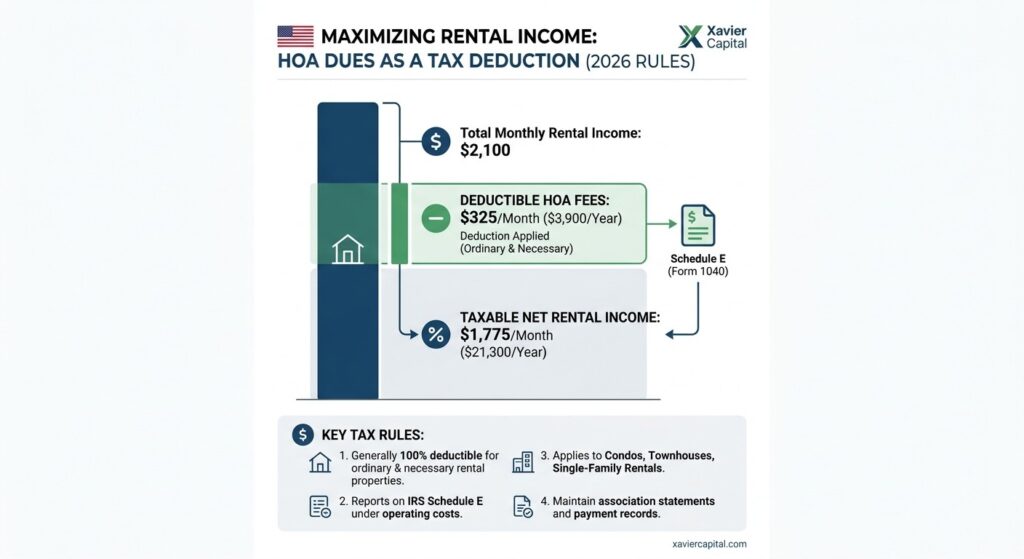
The timing is usually simple for cash-basis taxpayers: deduct dues in the year you pay them. Keep the association’s statements, canceled checks, bank records, and a copy of the annual HOA budget if available. Those documents help establish both the amount paid and the fact that the property was operated as a rental.
The IRS Schedule E instructions and Publication 527 recognize expenses such as management fees, maintenance, insurance, and other costs of operating rental property. HOA dues often cover several of these services in one monthly charge. You generally do not need to split the regular dues into landscaping, insurance, and amenities before deducting them.
What if the Property Was Both Personal and a Rental?
This is where the answer becomes less automatic. If you rented a beach condo for part of the year but used it personally as well, you may need to divide HOA dues between rental and personal use. Only the rental portion is potentially deductible.
The IRS vacation-home rules can also limit rental deductions when you use the home personally for more than the greater of 14 days or 10% of the days it is rented at a fair rental price. Publication 527 explains these limits. Your expenses may still be reportable, but the order and extent of the deduction can change.
Do not guess at the allocation. Maintain a calendar showing rental days, personal-use days, repair closures, and days the property was available for rent. A property that sits vacant while actively listed for rent is not the same as a property reserved for your family.
Special HOA Assessments May Be Different
Regular monthly or quarterly dues and special assessments do not always receive identical treatment. A special assessment for a capital improvement, such as replacing a community roof, adding a gate system, or reconstructing private roads, may not be a current rental deduction.
If the assessment improves the property, restores it after substantial deterioration, or adapts it to a new use, it may need to be capitalized instead. For a rental, that can mean adding the appropriate share to the property’s basis and recovering the cost through depreciation where permitted. For a personal home, a qualifying capital assessment may increase your basis, which could matter when you eventually sell.
Routine repairs and operating assessments are more likely to be currently deductible for a rental. Major improvement projects usually call for a closer look. Read the assessment notice, not just the amount on your bank statement. The association should identify what the money funds.
Can You Deduct HOA Fees for a Home Office?
Possibly, but this is a narrower opportunity than many self-employed homeowners expect. If you use part of your home regularly and exclusively for a qualified business, you may be eligible for the home office deduction. IRS Publication 587 explains the requirements and methods.
Under the actual-expense method, you may allocate indirect home expenses, potentially including a portion of HOA dues, based on the business percentage of your home. For instance, a 200-square-foot dedicated office in a 2,000-square-foot home represents 10% of the space. Depending on your facts and the services covered, 10% of eligible shared HOA dues may be part of your home office calculation.
The words “regularly” and “exclusively” do real work here. A kitchen table used for client calls, family meals, and homework does not qualify. A separate room used only to run your consulting, freelance, or online business is far easier to support.
If you use the simplified home office method, you do not separately deduct HOA dues. The simplified method uses a prescribed square-foot amount instead of tracking actual home expenses. It saves recordkeeping time, but it can produce a smaller deduction for owners with high home-related costs.
Employees generally cannot claim unreimbursed home office expenses on their federal return under current federal rules. This discussion is primarily for self-employed taxpayers, independent contractors, and qualifying business owners.
Avoid These Common HOA Fee Mistakes
First, do not place primary-home HOA dues on Schedule A as property taxes. They are not the same expense. Second, do not deduct 100% of dues when a property has personal and rental use. Third, do not treat every special assessment as a one-year write-off.
Also, be careful when your HOA bills you for a fine, late charge, or rule violation. A payment that is punitive or personal in nature deserves extra scrutiny. For rental owners, ordinary operating dues are the cleanest deduction. Fines and unusual charges require a review of the specific facts.
Finally, keep business and personal records separate. A dedicated bank account for a rental property makes it much easier to identify dues, repairs, utilities, and other Schedule E expenses. It also reduces the odds that you miss a valid deduction or claim one you cannot substantiate.
FAQs About Deducting HOA Fees
Are condo association fees tax deductible?
They are generally deductible for a condo held as a rental property. They are generally not deductible for a condo you use as your personal residence, except for a properly allocated business-use portion when you qualify for the actual home office method .
Can I deduct HOA fees if I rent out one room in my house?
Potentially, but only the portion connected to the rental activity may be deductible. The calculation depends on the rental area, the number of rental days, and whether you also use the space personally. Because room rentals can involve mixed-use rules, careful records matter.
Are HOA fees included in my property tax deduction?
No. Property taxes are levied by a governmental taxing authority. HOA dues are charges imposed by a private association under its governing documents. They may both be mandatory, but federal tax law treats them differently.
Where do I report deductible HOA fees for a rental?
Most individual landlords report them on Schedule E with other rental expenses. If your rental activity is operated through a business entity or involves unusual circumstances, the reporting form may differ.
Before filing your 2026 return, review the latest version of IRS Publication 527, Publication 587, and the Schedule E instructions. The smartest move is not trying to force a personal expense into a deduction. It is recognizing when your property is genuinely producing income, documenting the costs cleanly, and keeping more of the tax savings you are actually entitled to claim.
Paul Xavier
Editor & Contributor at Xavier Capital