

Updated October 2, 2026.
Is the U.S. economy in trouble in 2026? The country is still growing, but inflation, oil prices, interest rates, AI, and changing job patterns are creating new pressure for families and investors .
Inflation remains above the Federal Reserve’s long-term target. Oil prices are creating new pressure on gasoline and transportation costs. Interest rates are still restrictive, and artificial intelligence is changing how companies invest, hire, and compete.
At the same time, the economy continues to grow, consumer spending remains resilient, and unemployment is still relatively low.
So, is the U.S. economy in trouble in 2026?
The most accurate answer is more complicated than a simple “yes” or “no.” The economy is showing signs of resilience, but families and investors are dealing with a more uncertain environment. Growth is continuing, but the cost of living remains high. Jobs are still available, but some industries are changing rapidly. Financial markets may look strong, but household budgets are under pressure .
This article explains the most important economic trends in 2026 and what they could mean for your savings, income, debt, and investments.
The U.S. Economy Is Still Growing, but Growth Has Slowed
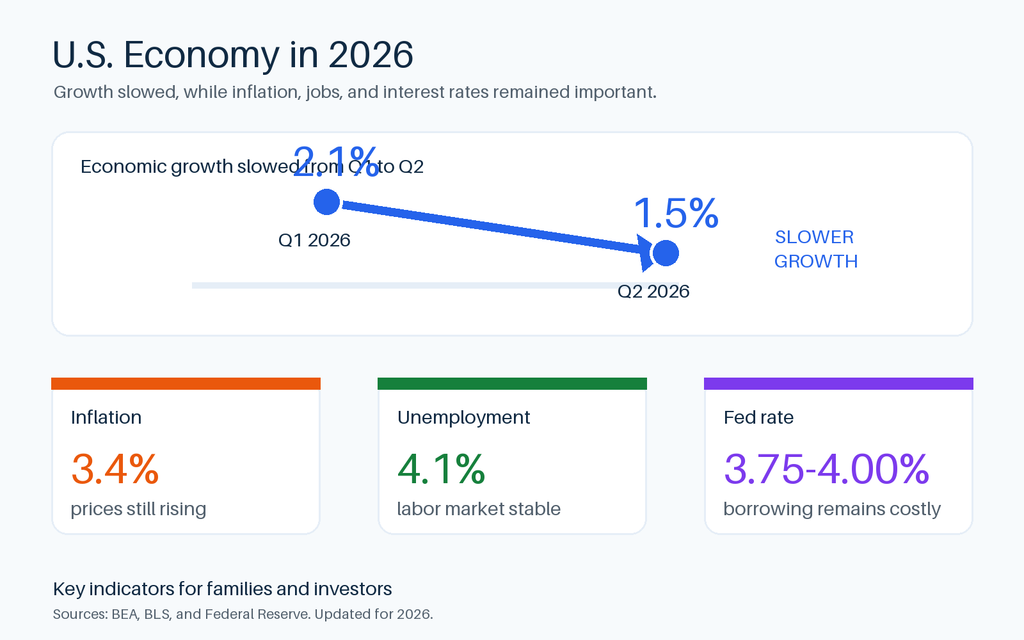
The U.S. economy continued to expand in the second quarter of 2026. The Bureau of Economic Analysis’ third estimate showed that real GDP grew at an annual rate of 2.2%, revised up from the earlier second estimate of 1.5%. Growth in the first quarter was 2.5%. Read the BEA’s third estimate for second-quarter 2026 GDP .
The September employment report showed that nonfarm payroll employment increased by 29,000 and the unemployment rate was 4.2%. The Bureau of Labor Statistics said both measures changed little during the month. See the BLS Employment Situation for September 2026 .
Taken together, these figures show continued but uneven growth. They do not, by themselves, confirm or rule out a recession.
The difference matters because slower growth can affect :
- Hiring decisions
- Wage increases
- Business profits
- Household confidence
- Stock market expectations
- Interest rate decisions
A slower economy can remain healthy for a long time. However , if consumer spending weakens while inflation remains high, the pressure on families and businesses can become more serious.
Inflation Is Still Affecting Household Budgets
The latest published Consumer Price Index report showed that prices rose 0.4% in August 2026 compared with July. Over the previous 12 months, the all-items index rose 3.4%, while core CPI, which excludes food and energy, rose 2.4%. Gasoline prices increased 3.9% during the month. Read the BLS August 2026 CPI report .
These figures describe national averages. A household’s experience can differ depending on where it lives and how much it spends on housing, transportation, food, insurance, and other expenses.
When inflation slows, prices are generally rising more slowly, not returning to earlier levels. That is why families can still feel squeezed even when inflation is below its past peak. For a closer look at how rising prices affect household budgets, read our guide to the impact of U.S. inflation in 2026 .
Gasoline and Oil Can Add Pressure
Fuel is one part of a household budget, but changes in energy costs can also affect transportation and the cost of moving goods. Those effects do not reach every family or business in the same way or at the same time.
Rather than assuming oil prices will follow a specific path, it is more useful to watch how fuel costs affect your own spending. Our analysis of oil prices in the U.S. looks at the issue in more detail.
Interest Rates Affect Borrowing and Saving
Interest rates can influence the cost of borrowing and the return available on some savings products. The effect depends on the loan or account: for example, a variable-rate balance may respond differently from a fixed-rate loan.
Federal Reserve decisions do not guarantee a particular future rate path. Households can focus on what they can verify now, such as the interest rate, fees, and terms on their existing accounts. Readers comparing cash savings options can also review our guide to high-yield savings accounts .
The Labor Market Can Differ by Industry
The September employment figures discussed above offer a national snapshot, not a complete picture of every occupation or community. A single monthly report should be considered alongside longer-term patterns and changes across industries.
Technology is also changing some tasks and job requirements. That does not mean every role will disappear, but it does make it useful for workers to understand how their field is evolving. Read our analysis of the U.S. job market in 2026 for more context.
What to Watch When Considering Recession Risk
The economic data in this article describe different parts of the economy. No single monthly release can settle whether households, businesses, or the wider economy are facing a downturn. Growth, employment, prices, spending, and financial conditions each provide different information.
For a deeper discussion of recession indicators and risks, read our U.S. recession guide for 2026 .
Practical Steps for Households
Economic uncertainty can be a reason to review a plan, not a reason to make a rushed financial decision. Consider:
- Review your budget. Compare recent spending with your current income and priorities.
- Build savings gradually. Choose an emergency-fund target that fits your essential expenses and situation. Our guide explains how to estimate an emergency fund .
- Understand high-interest debt. Review your interest rates, minimum payments, and options for paying down balances. See our guide to managing credit card debt while living paycheck to paycheck .
- Check the terms before borrowing. Compare the total cost, rate type, fees, and repayment period, not only the monthly payment.
- Avoid decisions based only on headlines. Make changes based on your own time horizon, cash needs, and tolerance for risk.
What Investors Can Keep in Mind
Economic headlines alone do not determine whether a particular investment is appropriate. Investors may find it useful to consider their time horizon, diversification, cash needs, risk tolerance, and the fundamentals of the assets they hold.
Economic reports are snapshots, and forecasts can change when new information arrives. A careful review of your own plan is more useful than assuming that one data point guarantees a particular market outcome.
Final Thoughts
The U.S. economy in 2026 combines continued growth with persistent pressure on household budgets. Inflation, energy costs, interest rates, labor-market shifts, and technology can affect families differently.
The figures in this article provide context, not a personal financial forecast. For households, a practical starting point is to understand monthly expenses, savings, and debt. For investors, it is to keep decisions aligned with their own goals and risk tolerance.
Related Articles in This Economy Cluster
This overview explains the broader picture. The articles below cover specific parts of the economy in more detail.
- Inflation in the U.S. in 2026: What Rising Prices Mean for Your Budget
- Interest Rates in 2026: What Borrowers and Savers Should Know
- U.S. Recession 2026
- Oil Prices and U.S. Households in 2026
Pingback: US Inflation Impact 2026: The Silent Threat to Your Cash
Pingback: High-Yield Savings Accounts 2026: Is Your Yield Losing to Inflation?
Pingback: Oil Prices Surge in the U.S.: What It Means for the Economy and Your Wallet in 2026 - Xavier Capital
Pingback: US Job Market 2026: Why Traditional Income is Failing
Pingback: U.S. Recession 2026: Is the American Economy Heading Toward a Crisis? - Xavier Capital
Pingback: AI and U.S. Jobs in 2026: What May Change and What Workers Can Do
Pingback: AI and Income Inequality in the U.S.: Who May Benefit?
Pingback: How Much Do I Need for an Emergency Fund? Find Out Yours - Xavier Capital