

Millions of hard-working families are trapped in a frustrating cycle. They secure raises, manage their monthly expenses with discipline, and avoid reckless spending—yet, at the end of every month, their bank accounts look exactly the same.
This frustrating phenomenon is what economists call the cash-flow illusion. In the current economic landscape, looking at your financial health through the lens of a flat salary is a massive mistake. High inflation, rising baseline costs, and subtle interest adjustments mean that even if your nominal income is steady, your actual purchasing power is leaking behind the scenes.
To break free from this systemic trap, you must audit your personal economy with corporate precision. As the core strategy teaches us: nothing is so perfect that it cannot be improved. If you keep using a stagnant strategy while the macroeconomic landscape shifts around you, you are quietly choosing to lose ground.
The Invisible Leaks: Breaking Down Household Liquidity Constraints
The primary reason your income seems to vanish isn’t a lack of effort; it is the compounding pressure of household liquidity constraints.
When the cost of essential goods adjusts upward, it creates a domino effect across your entire budget. For instance, the ongoing impact of US grocery inflation has forced families to reallocate funds that were originally earmarked for savings or debt reduction just to cover standard baseline living expenses.
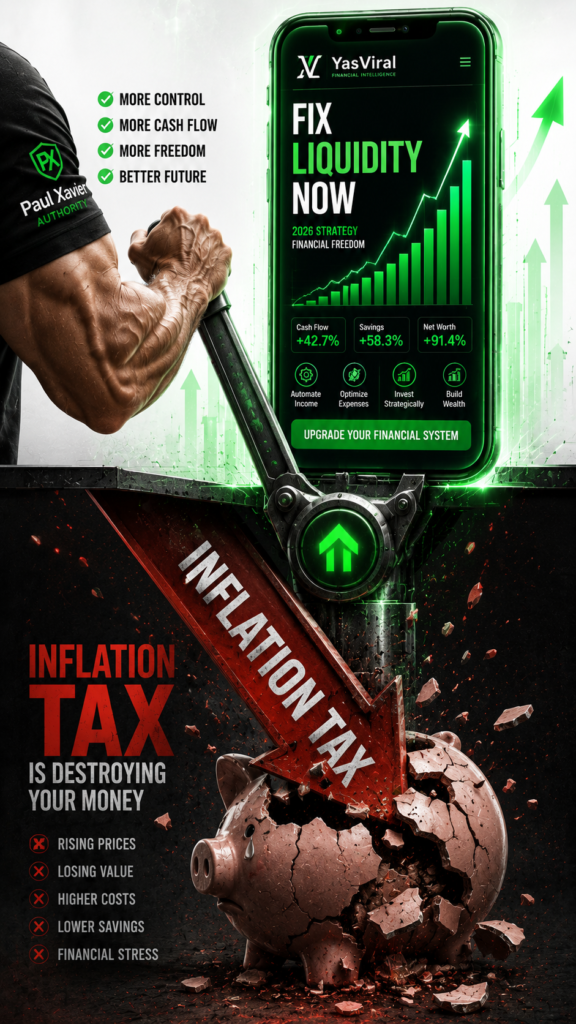
When you combine these inflated costs with variable interest rates on revolving accounts, your capital velocity drops to zero. To permanently stop wealth deflation, you cannot just try to out-earn the problem. You must systematically block the invisible leaks that drain your monthly margins.
Escaping the Stagnant Capital Trap
Most traditional financial advice tells you to ride out the storm and wait for market volatility to settle. But waiting is a losing playbook. In a high-inflation environment, stagnant money is losing money.
Your financial behavior must pivot to match the current reality. This means moving away from passive saving models and actively learning how to route your liquidity into agile tools that protect your purchasing power. Analyze where your capital is losing value daily, eliminate hidden institutional drains, and treat your household budget like a lean, profitable business.
Remember, you cannot solve modern economic challenges with an outdated, decade-old mindset. Every single layer of your current budget needs to be reviewed, optimized, and upgraded today to establish absolute control over your financial infrastructure.
FAQ: Reclaiming Your Monthly Cash Flow
What is the cash-flow illusion?
The cash-flow illusion occurs when your nominal income stays the same or increases, making you feel financially secure, while your actual purchasing power decreases due to rising structural costs and inflation. You feel like you are making money, but your real wealth is shrinking.
How does US grocery inflation affect my overall liquidity?
When essential baseline costs like groceries increase rapidly, they eat into your disposable income margins. This creates immediate liquidity constraints, leaving you with less cash to allocate toward strategic capital growth or emergency funds, forcing reliance on credit lines.
Why is dynamic capital velocity important?
Dynamic capital velocity means keeping your money moving into vehicles that actively match or beat current inflation rates. Leaving your capital stagnant in traditional accounts allows inflation to erode your standard of living, whereas high-velocity strategies protect your household liquidity.