

A profitable side hustle can create an unpleasant surprise when tax-filing season arrives: no employer has been withholding taxes from that income throughout the year.
The good news is that you can estimate your 2026 tax payments before the balance becomes a cash-flow problem. For freelancers, landlords, independent contractors, investors with taxable income, and business owners, the goal is not to predict the final number perfectly. It is to pay enough during the year to reduce the risk of an underpayment penalty and avoid an unnecessarily large tax bill later.
This guide focuses on the federal estimated-tax framework described by the Internal Revenue Service in Form 1040-ES and its instructions. State estimated-tax rules may be different, so your federal calculation is only one part of your overall plan.
Estimated taxes are not a punishment for earning more. They are a cash-flow system. Once you know your payment target, you can reserve the money before it gets spent somewhere else.
Who may need estimated tax payments ?
You may generally need to make estimated tax payments if you expect to owe at least $1,000 in federal tax after subtracting your withholding and refundable tax credits.
This often applies to:
- Freelancers and independent contractors
- Gig workers
- Sole proprietors and other small-business owners
- Landlords with taxable rental profit
- Retirees receiving taxable retirement distributions
- Investors realizing taxable capital gains
- Employees whose bonuses, investment income, or other earnings are not fully covered by withholding
Employees may not always need separate estimated payments. If you receive a regular paycheck, increasing your federal withholding may be simpler. Withholding is generally treated as paid throughout the year, which can make it a useful way to correct a shortfall later in the year.
The estimated-tax safe harbor
The safe harbor is a penalty-protection rule. It does not necessarily equal the total tax you will owe when you file your return.
You generally may avoid an underpayment penalty when your withholding and timely estimated payments equal at least one of these amounts:
- 90% of your current-year total tax, or
- 100% of your prior-year total tax
The prior-year threshold generally increases to 110% when your prior-year adjusted gross income was more than $150,000, or more than $75,000 if you used married filing separately.
Your prior-year return generally must have covered a full 12-month tax year for the prior-year safe harbor to apply.
For example, paying enough to meet the safe harbor may protect you from a penalty, but it may not cover the full amount due when you file. If your income increases sharply, you could still owe a substantial balance even when your payments were sufficient for penalty protection.
How to calculate estimated tax payments step by step
Step 1: Estimate your full-year income
Start with a realistic forecast of your taxable income for the entire year. Include expected income from sources such as:
- W-2 wages
- Net self-employment or business income
- Rental profit
- Interest and dividends
- Capital gains
- Retirement distributions Retirement income can also affect your overall tax planning. If you are comparing retirement contribution strategies, learn more in our guide to Traditional vs. Roth 401(k) in 2026 .
- Royalties and other taxable income
If your income changes from month to month, do not use your best month as the yearly forecast. Use year-to-date results, current contracts, known investment transactions, and a reasonable estimate of the remaining months.
Your estimate should be based on net taxable income, not simply the total amount deposited into your bank account.
Step 2: Estimate deductions and credits
Next, estimate the deductions and tax credits that may reduce your taxable income or total tax .
For business or freelance income, review ordinary and necessary business expenses. For rental income, consider eligible operating expenses, depreciation, and other relevant deductions. Also review credits that may apply to your household, education, health insurance, or qualifying energy improvements.
Qualifying home improvements may also affect your tax calculation. See our guide to claiming home energy credits on your 2025 tax return .
Be conservative with deductions that are uncertain or subject to limitations. A payment made from a business bank account is not automatically deductible. Home-office expenses, vehicle costs, depreciation, passive losses, and other deductions require proper eligibility and documentation.
Step 3: Include self-employment and other applicable taxes
Your estimated amount may include more than regular federal income tax.
If you earn income from self-employment, you may also owe self-employment tax for Social Security and Medicare. Depending on your circumstances, your estimate may need to account for additional Medicare tax, net investment income tax, or tax connected with certain retirement distributions.
The IRS worksheet in Form 1040-ES can help organize income, deductions, credits, self-employment tax, and withholding in one calculation. A tax professional or tax-preparation software may also help when your income comes from several sources.
Step 4: Calculate your projected tax shortfall
Subtract the federal withholding and tax payments you expect to make during the year from your projected total federal tax.
For example, suppose Maya expects the following for 2026:
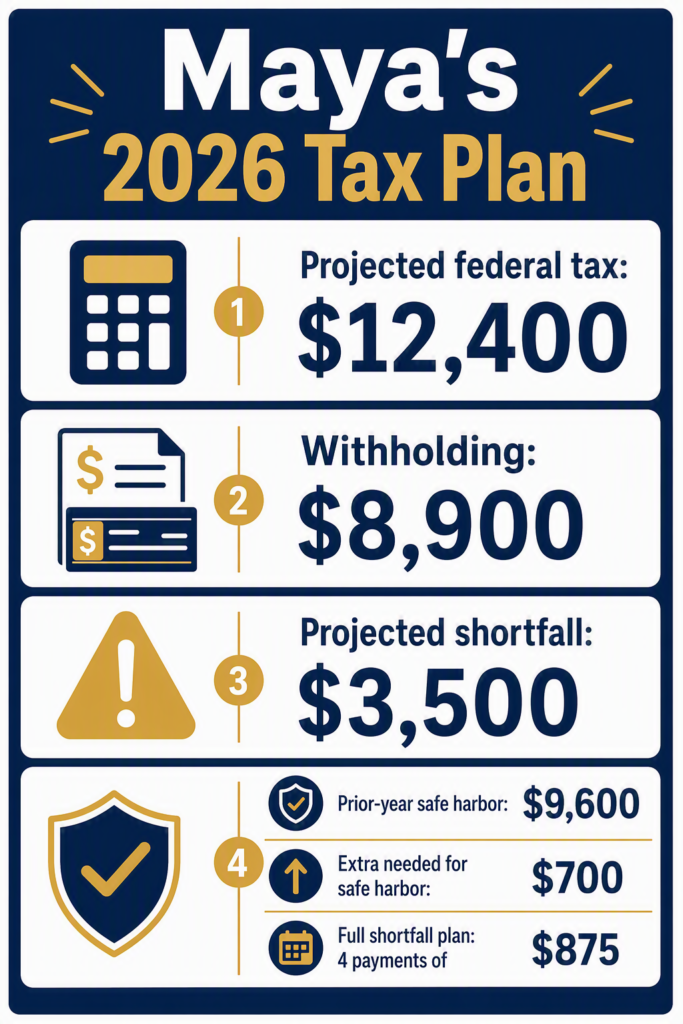
- Projected total federal tax: $12,400
- Expected federal withholding from her job: $8,900
- Estimated shortfall: $3,500
If Maya wants to cover the full projected shortfall, she could plan for $3,500 in estimated payments during the year. This is a cash-flow target, not a guarantee of her final tax bill.
This is a natural place to link to the published Xavier Capital budgeting article, because readers who identify a tax shortfall also need a simple system for reserving the money. Add the exact article URL when placing the link in WordPress.
Step 5: Compare the shortfall with the safe-harbor target
Now compare the current-year calculation with the safe harbor.
Suppose Maya’s 2025 total tax was $9,600 and her prior-year adjusted gross income was below the higher-income threshold. Ninety percent of her projected 2026 tax is $11,160. The lower of the two safe-harbor targets is therefore $9,600.
Because Maya expects $8,900 in withholding, she would need at least $700 in additional payments or withholding to reach that safe-harbor target.
But the $700 target and the $3,500 projected shortfall serve different purposes:
- Paying $700 may be enough to meet the prior-year safe harbor and reduce penalty risk.
- Paying $3,500 is designed to cover the expected tax gap and reduce the bill at filing time.
Choose the target that fits your cash-flow plan, but do not confuse penalty protection with paying the full tax liability .
Step 6: Divide the target across the payment dates
For most calendar-year taxpayers, the standard federal estimated-tax payment dates for 2026 are:
| Payment period | General due date |
|---|---|
| First payment | April 15, 2026 |
| Second payment | June 15, 2026 |
| Third payment | September 15, 2026 |
| Fourth payment | January 15, 2027 |
If a deadline falls on a weekend or federal holiday, the deadline may move to the next business day. Confirm the current date and payment instructions in the IRS Form 1040-ES materials before submitting a payment.
If Maya divides her projected $3,500 shortfall equally, each installment would be $875. If she only plans to close the $700 safe-harbor gap, four equal payments would be $175 each.
Equal installments work best when your income arrives relatively evenly. If your income is seasonal or arrives in large irregular amounts, the annualized-income installment method may produce a more accurate result. It requires additional recordkeeping, but it may help when most of your taxable income arrives late in the year.
Build a system for reserving the money
Estimated taxes are easier to manage when the tax reserve does not feel like available spending money.
Each time you receive self-employment, rental, or other income without withholding, consider transferring part of it to a separate savings account reserved for taxes. A separate annual budget can help you plan these tax reserves alongside regular expenses, savings goals, and other financial obligations. Read our guide to creating an annual budget plan for 2026 . There is no universal percentage that works for everyone. The appropriate amount depends on your tax bracket, self-employment tax, deductions, credits, state tax, and total household income .
Review your estimate after major changes, including:
- Signing a new client or contract
- Buying a significant business asset
- Selling rental property
- Receiving a large bonus
- Selling investments for a gain
- A spouse changing jobs
- Experiencing a major business loss
Waiting until the next scheduled payment may leave you with too little time to correct a large change comfortably.
This section can later link to the Xavier Capital article about building and maintaining a monthly budget. Add that published URL when the article is edited in WordPress.
Common mistakes to avoid
Calculating tax on gross business deposits
Taxes are generally based on taxable profit, not simply the amount deposited into your account. Track eligible business expenses, but do not claim deductions without adequate records or eligibility.
Treating the safe harbor as the final bill
The safe harbor is primarily a penalty-protection threshold. You may still owe more when filing if your current-year tax is higher .
Forgetting self-employment tax
Independent contractors and sole proprietors may owe both income tax and self-employment tax. Leaving out the second component can make an estimate significantly too low.
Ignoring investment income
Interest, dividends, capital gains, and retirement distributions can increase your total tax even when your paycheck withholding has not changed.
Assuming federal and state rules are identical
Many states have their own thresholds, forms, payment schedules, and safe-harbor rules. Review your state revenue agency’s current guidance separately.
Paying under the wrong tax year or taxpayer identification information
Keep confirmation records for every payment. Verify the tax year, taxpayer information, payment amount, and filing status when submitting electronically or by mail.
Frequently asked questions
Can I pay all my estimated tax early?
You can pay the full expected amount early, which may simplify your planning. Paying one large amount late, however, may not remove a penalty for earlier periods. The timing of payments can matter as much as the total amount paid.
What if my income changes after I make a payment?
Recalculate your projection. You are not locked into the original estimate. Increase later payments when income rises, or reduce them when a legitimate loss, deduction, or income change lowers your projection. Continue to monitor the safe-harbor target.
Are federal estimated tax payments deductible?
Federal estimated income-tax payments are prepayments of your federal tax liability. They are not a federal deduction that reduces your taxable income.
Do I also need to make state estimated tax payments ?
Possibly. State requirements vary, so calculate your federal obligation separately and review your state’s current rules.
Can increasing paycheck withholding replace estimated payments?
For some employees, yes. Increasing federal withholding may be simpler than making separate estimated payments, especially when the shortfall comes from a bonus, investment gain, or a spouse’s income. Review the result carefully so the new withholding is not too low or unnecessarily high.
Final takeaway
Estimated tax payments are a way to give future tax obligations a place in your current budget. Estimate your full-year income, account for deductions and credits, include self-employment and other applicable taxes, compare the result with the safe harbor, and update the calculation when your income changes.
The objective is not perfect prediction. It is a realistic plan that protects cash flow and reduces the chance that your tax bill will compete with your emergency fund, mortgage, or next investment opportunity.
Disclaimer: This article provides general educational information about federal estimated taxes. It is not individualized tax, legal, or financial advice. Tax rules and personal circumstances vary. Review the current IRS guidance and consider consulting a qualified tax professional before making payment decisions.
Suggested call to action:
Do you earn income outside a regular paycheck? Start by estimating your annual tax shortfall and creating a separate reserve for it. A simple monthly review can make estimated payments much easier to manage .