
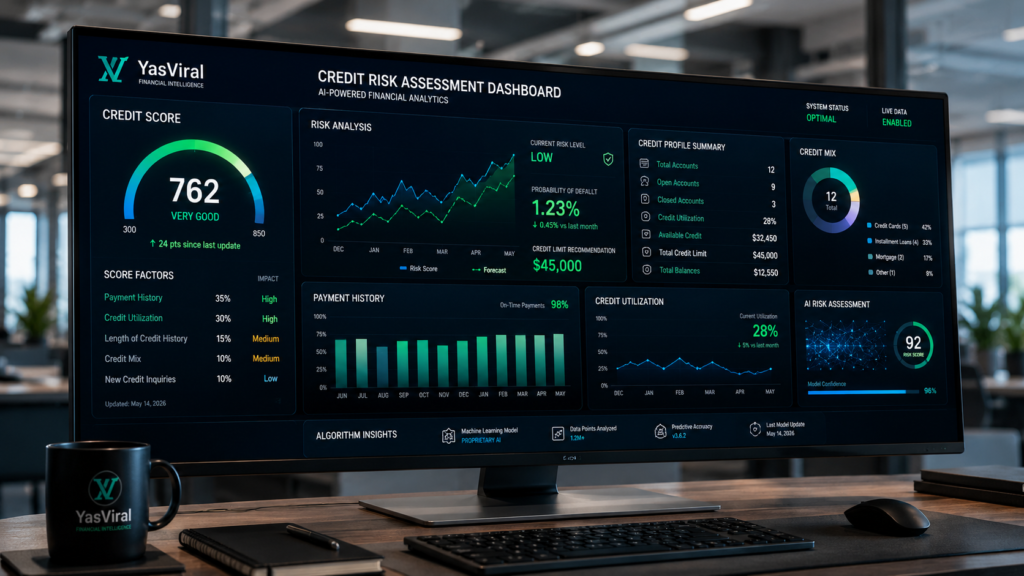
Managing your financial profile in the United States used to be a predictable task. You paid your credit card bills on time, kept your utilization low, and watched your traditional FICO score climb. However, as we move through 2026, the underlying infrastructure of lending institutions has quietly transformed. Today, major banking entities are moving past legacy metrics to implement advanced AI credit scoring models 2026 that look at your financial life through a completely different lens.
If your traditional score is excellent but you are still facing unexpected borrowing limits, you are likely hitting modern algorithmic constraints. Understanding this hidden system is the only way to safeguard your purchasing power.
The Shift to Behavioral and Real-Time Data
Traditional underwriting relied on static, historical snapshots updated once a month. Modern generative and predictive engines, however, track real-time capital velocity. These new automated systems evaluate macro-financial health by analyzing micro-behaviors:
- Transaction Consistency: Algorithms observe the exact timing of your utility payments and structural household commitments, treating slight variations as liquidity signals.
- Cash-to-Debt Ratios: Instead of looking just at overall credit limits, systems calculate how fast liquid capital moves through your accounts versus your active liabilities.
- Macroeconomic Vulnerability: If a consumer relies heavily on floating-rate credit lines during subtle inflationary shifts, the model automatically triggers a risk constraint, regardless of a high baseline FICO number.
According to chief financial strategists, relying on a financial playbook from a decade ago to navigate today’s automated system is a major vulnerability. The modern infrastructure requires dynamic asset positioning.

Overcoming Modern Credit Constraints
To ensure your profile remains highly rated by automated underwriting algorithms, you must shift your focus from simply maintaining a number to demonstrating structural stability.
First, address any hidden household liquidity constraints by ensuring your primary checking accounts maintain a consistent, positive cash buffer for at least 45 consecutive days. Automated banking models flag low balances right before recurring cycles as high-risk anomalies. If you need a comprehensive tool to map out these patterns and actively rebuild your capital footprint, you can utilize an automated system like Credit Seasoning & Optimization Tools .
Second, consolidate fragmented micro-debts. Having multiple open balances on retail or digital lines of credit—even with perfect repayment history—distorts the behavioral patterns analyzed by predictive scoring engines.
To benchmark your current stand against federal consumer guidelines, you can review the latest structural insights provided by the official Consumer Financial Protection Bureau (CFPB). Navigating this shift aligns perfectly with the agile cash-flow methodology we explored in our previous guide on overcoming household liquidity constraints), ensuring your infrastructure is fully optimized.
The Verdict: Partnering with the Machine
The automation of credit risk isn’t designed to lock out disciplined consumers; it is designed to filter out structural volatility. By aligning your monthly cash flow with a strategy that prioritizes liquid stability and clean transactional footprints, you position your portfolio to win under any algorithmic review.
The future of capital access belongs to those who understand how the machine thinks. Secure your infrastructure today, adjust your velocity, and build an unshakeable profile for the modern era.
Frequently Asked Questions (FAQ)
What are AI credit scoring models?
AI credit scoring models are advanced algorithms used by modern financial institutions to evaluate a borrower’s risk. Unlike traditional FICO scores that rely purely on historical payment records, these systems analyze real-time behavioral data, cash flow velocity, and spending patterns to predict future creditworthiness.
Why did my credit limit drop if my FICO score is high?
Lenders in 2026 are heavily prioritizing automated risk constraints over legacy numbers. If an algorithm detects cash flow fluctuations, high utilization of hidden digital credit lines, or a low cash buffer in your primary accounts, it may automatically restrict your capital access to mitigate systemic risk.
How do you fix behavioral algorithmic constraints?
To satisfy AI scoring systems, you must build a clean transactional footprint. Maintain a stable liquid balance in your checking accounts across billing cycles, avoid opening multiple micro-credit lines simultaneously, and ensure your daily capital velocity remains steady and predictable.