

While our previous article explained the main tax deductions available to side-hustle owners, this guide focuses on a practical example showing how a $5,000 deduction may affect taxable income and estimated tax savings.
A $5,000 side-hustle expense deduction is not the same as getting $5,000 back from the IRS. But it can still keep more than $1,500 in your pocket, depending on your income, filing status, and the deductions you qualify for. This side hustle tax savings example uses federal rules for 2026 planning and the IRS framework for sole proprietors reporting business income and expenses on Schedule C.
The IRS generally allows a deduction when an expense is both ordinary and necessary for your trade or business. That standard comes from IRS guidance for Schedule C filers, and it is the line between legitimate tax planning and trying to write off everyday personal spending. Let’s be candid, buddy: a deduction is valuable, but only when the expense actually belongs to the business and you can prove it.
> “The best side-hustle deduction is not the flashiest one. It is the ordinary expense you tracked all year, can explain clearly, and would be comfortable defending with a receipt.” – Paul Xavier
A Side Hustle Tax Savings Example With $5,000 of Expenses
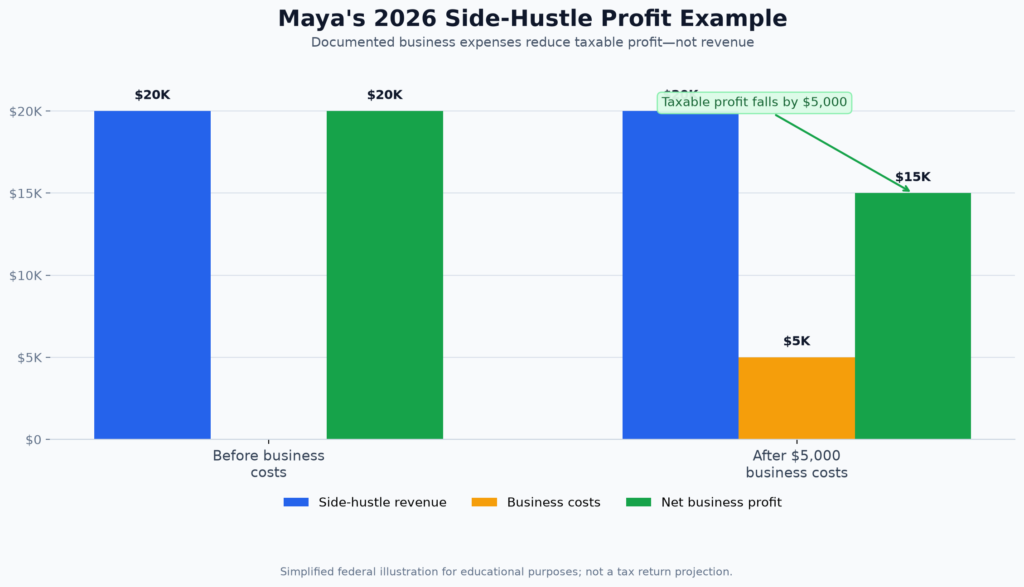
Assume Maya works a full-time job and earns freelance design income on the side. During 2026, her side hustle brings in $20,000. She pays $5,000 for legitimate business costs: design software, a dedicated website, advertising, contractor help, business insurance, and a portion of her phone bill that is documented as business use.
Without those costs, Maya reports $20,000 of net profit on Schedule C. With them, she reports $15,000. Her revenue did not change, but her taxable business profit did.
To keep the math useful, assume Maya is in the 22% federal marginal income-tax bracket before considering the side-hustle deduction. We will also account for self-employment tax, which applies to many freelancers and sole proprietors. This is a simplified federal illustration, not a tax return projection.
Step 1: The expense reduces self-employment tax
Self-employment tax generally covers Social Security and Medicare taxes for people working for themselves. The headline rate is 15.3%, but the calculation generally applies to 92.35% of net self-employment earnings.
On Maya’s $5,000 deduction, the approximate self-employment tax reduction is:
$5,000 × 92.35% × 15.3% = about $706
That is real tax savings, separate from federal income tax. It is one reason a business expense can be worth more to a side-hustle operator than it would be to an employee with no business income.
Step 2: The expense reduces federal income tax
The $5,000 expense also lowers Maya’s business profit. However, there is a small wrinkle: when self-employment tax falls, the deduction for one-half of self-employment tax also falls. That partially offsets the income-tax benefit.
In this example, Maya’s decrease in deductible half of self-employment tax is roughly $353. Her federal taxable-income reduction is therefore closer to $4,647 than the full $5,000.
At a 22% marginal rate, that produces an estimated income-tax reduction of:
$4,647 × 22% = about $1,022
Add the estimated $706 reduction in self-employment tax, and Maya’s $5,000 in deductible expenses saves approximately $1,728 in federal taxes.
Her out-of-pocket business spending was still $5,000. The deduction does not make the costs free. It reduces their after-tax cost. Put differently, after estimated federal tax savings, those $5,000 of necessary expenses effectively cost Maya about $3,272.
Why Your Result May Be Higher or Lower
Maya’s $1,728 savings is an example, not a promise. Your marginal tax bracket makes a major difference. Someone in the 12% bracket generally saves less in federal income tax from the same deduction than someone in the 24% bracket.
The qualified business income deduction can also affect the result. Eligible sole proprietors may qualify for a deduction of up to 20% of qualified business income, subject to taxable-income limits and other rules. Because business expenses lower qualified business income, an expense may also reduce the size of that deduction. That does not make expenses a bad idea. It simply means the shortcut of multiplying an expense by your tax bracket can overstate savings.
State income tax matters as well. A resident of a state with income tax may see additional savings, while someone in a state without individual income tax will not. Your self-employment tax could also work differently if your total wages and self-employment income exceed annual Social Security wage limits.
This is why “I wrote it off” should never mean “it cost me nothing.” Spend money to earn income, improve your operation, or protect the business – not just to chase a deduction.
Expenses That Commonly Create Legitimate Savings
For most side hustles, the strongest deductions are ordinary operating costs that directly support earning income. A photographer may deduct editing software and client travel. A reseller may deduct inventory, marketplace fees, packaging, and shipping. A consultant may deduct a business domain, professional software, advertising, and bookkeeping costs.
Vehicle costs require extra care. If you use a car for business, you may generally choose the standard mileage method or actual vehicle expenses when eligible, but you cannot claim both for the same business use. Commuting from home to a regular workplace is usually personal, even if you have a side hustle. Track the date, destination, business purpose, and mileage as it occurs, not months later when the details are fuzzy.
A home-office deduction can be legitimate, too, but the space must generally be used regularly and exclusively for business. Your kitchen table usually does not qualify if your household also uses it for meals, homework, and mail. A separate room or clearly defined area used only for the business is a stronger fact pattern.
Personal costs do not become deductible just because you own a business. Regular clothing, family groceries, personal streaming services, and the full cost of a phone used partly for personal calls are common examples. Deduct the documented business portion, not a hopeful estimate.
Build Records Before Tax Season Builds Pressure
The IRS does not require a fancy system, but it does expect records that support income and deductions. Keep receipts, invoices, bank and card statements, mileage logs, and notes explaining the business purpose of unusual purchases. A separate business checking account and card can make this dramatically easier, even for a small sole proprietorship.
Reconcile income and expenses monthly. This takes less time than trying to reconstruct a year of transactions in March, and it gives you a clearer picture of whether the side hustle is actually profitable. It also helps you set aside money for estimated taxes if you expect to owe.
IRS publications and Schedule C instructions are the primary references for federal business-expense rules. For mileage rules, home-office requirements, depreciation, and estimated tax payments, use current IRS guidance for the tax year you are filing. Tax rules and thresholds can change, so confirm details before submitting a 2026 return in 2027.
FAQs About Side Hustle Tax Savings
How much does a $1,000 side-hustle deduction save on taxes?
It depends on your federal bracket, state tax rate, and whether the deduction also lowers self-employment tax. For a profitable sole proprietor in a 22% federal marginal bracket, a $1,000 expense may save roughly $300 to $350 in combined federal income and self-employment taxes before considering factors such as the qualified business income deduction.
Can I deduct expenses if my side hustle did not make a profit?
Possibly, if you are operating a real business with a genuine profit motive. A loss may be deductible against other income in some situations, but repeated losses can lead to questions about whether the activity is a business or a hobby. Keep evidence that you are trying to make money: pricing decisions, marketing, customer records, a business plan, and consistent bookkeeping all help establish the facts.
Do I need an LLC to claim side-hustle deductions?
No. A sole proprietor can generally deduct qualifying business expenses without forming an LLC. An LLC can offer legal and organizational benefits, but it does not automatically create a new federal income-tax deduction.
Should I buy equipment before year-end for the deduction?
Buy it if the business needs it and the purchase makes financial sense. Some equipment may be deducted immediately under applicable rules, while other property may need to be depreciated over time. Do not let a tax deadline push you into buying something that will sit unused.
A well-run side hustle does more than generate extra income. It gives you the chance to make intentional decisions about costs, records, and taxes. Keep the receipt, document the purpose, and let every legitimate dollar you spend do its proper job.
Pingback: What the 2026 Tax Brackets Mean for You - Xavier Capital