

A dividend deposit can feel like free money – until tax time. Are dividends taxable? In most cases, yes. The tax you may owe depends on the type of dividend, the account holding the investment, your taxable income, and sometimes your state.
The basic distinction is between ordinary dividends, which are generally taxed at ordinary federal income-tax rates, and qualified dividends, which may receive the lower long-term capital-gains rates. Reinvesting a dividend usually does not make it tax-free in a regular brokerage account.
Dividends can support a long-term plan, but they are still part of your investment income. Include them in your tax planning before you spend the cash. – Paul Xavier
This guide covers federal rules for tax year 2026. Tax rules can change, and individual situations differ; use your tax documents and current IRS guidance when preparing a return.
Are Dividends Taxable in 2026?
Dividends paid into a taxable brokerage account are generally taxable for the year you receive them. That is usually true whether you withdraw the cash, leave it in the account, or automatically reinvest it to buy more shares.
Your Form 1099-DIV helps identify the income. Box 1a reports ordinary dividends; Box 1b reports the portion of those dividends that may qualify for the lower qualified-dividend rates. Box 1b is included in Box 1a – it is not extra income to add a second time.
For 2026, qualified dividends may be taxed at 0%, 15%, or 20%, depending on your filing status and taxable income. Ordinary dividends generally follow the ordinary federal income-tax rates that apply to your income. State tax may also apply.
That difference can affect an investment’s after-tax return. A stock with a higher dividend yield is not automatically a better choice than an investment with a lower yield and more potential for growth. Consider taxes alongside risk, diversification, fees, and your need for current income.
2026 Qualified-Dividend Tax Brackets
Qualified dividends use the same federal rate structure as long-term capital gains. The table shows the 2026 taxable-income ceilings published by the IRS. The 0% rate can apply up to the first amount; the 15% rate generally applies above that amount and up to the second; the 20% rate generally applies to the portion above the second amount.
| Filing status | 0% rate up to taxable income | 15% rate up to taxable income | 20% rate generally begins above |
|---|---|---|---|
| Married filing jointly or surviving spouse | $98,900 | $613,700 | $613,700 |
| Married filing separately | $49,450 | $306,850 | $306,850 |
| Head of household | $66,200 | $579,600 | $579,600 |
| Single / other individuals | $49,450 | $545,500 | $545,500 |
These are taxable-income thresholds, not gross-income limits. Qualified dividends are generally stacked on top of your other taxable income when the applicable rate is determined. In practice, a return can include amounts taxed at more than one rate. Estate and trust thresholds are not included here.
What Makes a Dividend Qualified?
A dividend generally must meet IRS requirements to receive qualified-dividend treatment. The payment must come from a U.S. corporation or an eligible foreign corporation, and you must meet the required holding period. Other rules can disqualify a payment in particular circumstances.
For common stock, you generally must hold the shares for more than 60 days during the 121-day period that begins 60 days before the ex-dividend date. For certain preferred stock dividends attributable to periods totaling more than 366 days, the holding-period test is generally more than 90 days during a 181-day period beginning 90 days before the ex-dividend date.
This is why buying shares just before the ex-dividend date, receiving the payment, and selling soon afterward does not automatically qualify the dividend for the lower rate. The payment may still be taxable, but it may be treated as ordinary income.
Some payments that investors informally call dividends do not qualify. REIT distributions are often ordinary dividends, although some qualified REIT dividends may be eligible for a separate qualified business income deduction if the taxpayer meets the rules. Mutual funds and ETFs may also report more than one type of distribution. Check the tax classification on the final tax documents rather than relying on the fund’s advertised yield.
A Simple Example
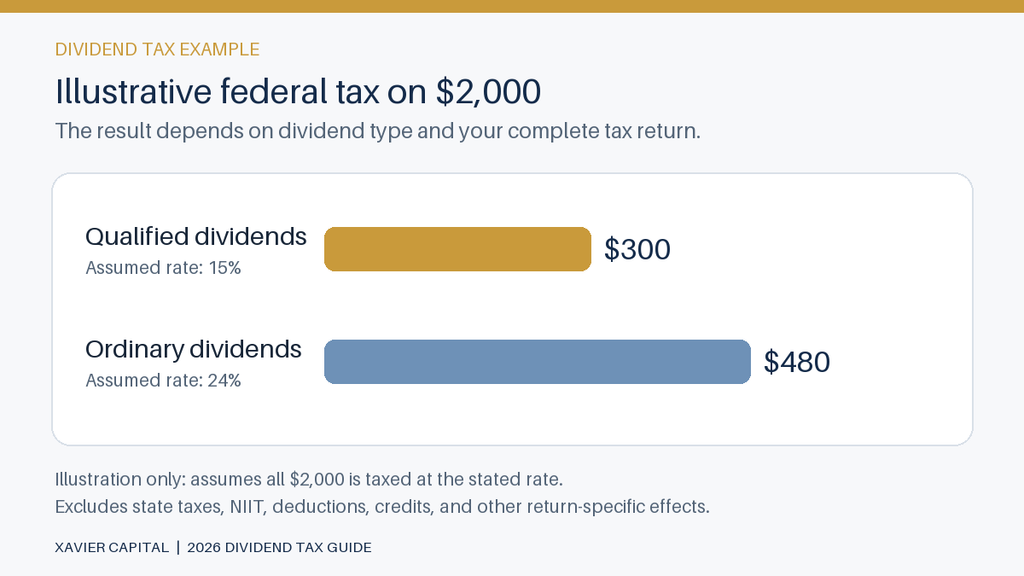
Suppose you receive $2,000 in dividends in a taxable brokerage account. If all $2,000 is qualified and falls within the 15% rate band, the simplified federal tax on that income would be $300. If the same $2,000 is ordinary dividend income and all of it falls within a 24% marginal rate, the simplified federal tax would be $480.
The comparison is illustrative, not a personal tax estimate. Your actual tax depends on your full return, including filing status, other income, deductions, qualified dividends and capital gains, state tax, and any applicable surtaxes.
Where You Hold the Investment Changes the Answer
The account can matter as much as the investment.
- Taxable brokerage account: Dividends are generally taxable in the year paid, including dividends automatically reinvested to buy additional shares.
- Traditional IRA or 401(k): Dividends generally are not taxed when they are earned inside the account. Distributions are usually taxed later under the rules for that account, commonly as ordinary income.
- Roth IRA or 401(k): Dividends generally are not currently taxable inside the account. Qualified withdrawals are generally tax-free; nonqualified withdrawals can have different tax consequences.
Tax treatment is only one part of choosing an account or investment. Fees, investment risk, diversification, withdrawal rules, and your time horizon also matter. For a related discussion of account trade-offs, see Traditional vs. Roth 401(k): Which Is Better in 2026? .
Do You Owe Tax if You Reinvest Dividends?
Usually, yes, when the investment is held in a taxable brokerage account. If an ETF pays a $100 dividend and your broker automatically uses it to buy more shares, the dividend is generally still taxable income for that year. Reinvestment changes what happens to the cash; it does not erase the dividend income.
The reinvested amount generally becomes part of the cost basis of the newly purchased shares. Keeping accurate basis records can help you avoid being taxed twice on the same dollars when you later sell. Brokers often report basis for covered securities, but retain year-end statements and records of transfers between firms.
Other Dividend Taxes That Can Affect Your Return
State income tax: Some states tax dividend income. The treatment of qualified dividends can differ from federal treatment, and some states do not impose a broad individual income tax. Check the rules for your state.
Net Investment Income Tax (NIIT): Some higher-income taxpayers may owe an additional 3.8% tax. The NIIT generally applies to the lesser of net investment income or the amount by which modified adjusted gross income exceeds the applicable threshold. The thresholds are generally $200,000 for single filers and heads of household, $250,000 for married couples filing jointly, and $125,000 for married taxpayers filing separately. It is not automatically charged on every dollar of dividend income just because a taxpayer’s income is above a threshold.
Foreign tax: A foreign government may withhold tax from dividends paid by an international company or fund. Form 1099-DIV may report foreign tax paid in Box 7. Depending on your circumstances and the applicable rules, you may be able to claim a foreign tax credit or deduction.
Nondividend distributions: A return of capital is generally reported in Box 3 of Form 1099-DIV. It typically reduces your cost basis instead of being taxed immediately as dividend income. After your basis reaches zero, additional return-of-capital distributions are generally treated as capital gain.
How to Plan for Dividend Taxes Before Filing
- Review income during the year. Track dividends and other investment income before tax season. If you also earn income from freelancing, rental property, or a side business, include it in your overall estimate. Xavier Capital’s guide to estimated tax payments for 2026 explains the basics.
- Use the final tax documents. Review each box on Form 1099-DIV. Funds may reclassify distributions after year-end, and brokers sometimes issue corrected forms. If a corrected form arrives after you file, ask a tax professional whether you need to amend your return.
- Compare after-tax outcomes, not yield alone. A high-yield investment may provide useful income, but it can also create more taxable income in a brokerage account. A lower-yield investment may suit a different goal. Neither approach is best for every investor.
- Keep basis records. Save statements showing reinvested dividends and share purchases, especially after moving assets between brokers.
FAQs About Taxable Dividends
Do I have to report dividends under $10?
Generally, yes: taxable income may need to be reported even when a payer is not required to send you Form 1099-DIV because the amount is below the usual reporting threshold. The threshold concerns the payer’s information-return requirement; it does not by itself make income tax-free. Check the current form instructions for exceptions and special reporting rules.
Are dividends in a Roth IRA taxable?
Dividends earned inside a Roth IRA generally are not currently taxable. Qualified withdrawals are generally tax-free. Nonqualified withdrawals may have different consequences, especially when earnings are withdrawn before applicable requirements are met.
Are ETF dividends taxable?
They generally are taxable when the ETF is held in a taxable brokerage account. A fund may distribute qualified dividends, ordinary dividends, capital-gain distributions, or other amounts. Use the final Form 1099-DIV rather than assuming every payment has the same tax treatment.
Can I avoid taxes on dividends by reinvesting them?
No. Reinvesting a dividend in a taxable account generally does not make it tax-free. Tax-advantaged accounts may change when or how investment income is taxed, but account rules, contribution limits, distribution rules, and your broader plan all matter.
The Bottom Line
Dividends can be a useful part of a long-term financial plan, but taxable-account dividends are generally still income even when reinvested. Check whether payments are qualified, review the account that holds the investment, keep basis records, and plan using your complete tax picture – not yield alone.
This article is for educational purposes only and is not tax, legal, or investment advice. Tax rules can change and individual circumstances differ. Consult current IRS guidance or a qualified tax professional about your situation.
Editorial source notes
- IRS, Revenue Procedure 2025-32, for inflation-adjusted capital-gain rate thresholds for tax year 2026.
- IRS, Publication 550 (2025 edition), for general rules on investment income and qualified dividends. Confirm the latest available edition before publication.
- IRS, Instructions for Form 8960, for Net Investment Income Tax rules and thresholds.
- IRS, Instructions for Form 1099-DIV, for information-return boxes and payer reporting requirements; use the latest edition available when finalizing the page.
The 2026 capital-gain thresholds above are based on Revenue Procedure 2025-32. Review all linked source documents again before publishing if tax law or IRS guidance has changed since
Pingback: What the 2026 Tax Brackets Mean for You - Xavier Capital