

A property tax bill can feel like a yearly cost of owning a home. The federal tax rules may reduce part of that burden, but only if you use the right deduction and qualify to claim it.
The first question is not simply, “How much property tax did I pay?” The more important question is whether claiming that expense as an itemized deduction gives you a better result than taking the standard deduction.
For tax year 2026, the federal standard deduction is $16,100 for single filers and married couples filing separately, $32,200 for married couples filing jointly, and $24,150 for heads of household. Property taxes generally help only when your eligible itemized deductions are greater than the standard deduction for your filing status .
How the property tax deduction works
For a personal residence, qualifying real estate taxes are generally claimed as an itemized deduction on Schedule A, which is filed with Form 1040. You do not claim the personal property tax deduction separately from your other itemized deductions.
Most individual taxpayers use the cash method. That generally means the deduction follows the year you actually paid the tax, not necessarily the year printed on the bill. Property taxes paid during 2026 generally belong on your 2026 federal return, which most taxpayers file in 2027.
The IRS generally requires the tax to be imposed by a state or local government and based on the assessed value of the property. A county, city, town, or school-district real estate tax commonly falls within this category. Review IRS Publication 530 and the current Schedule A instructions for the details that apply to your situation.
The 2026 SALT limit matters
Property taxes are part of the state and local tax deduction, commonly called the SALT deduction. You generally combine qualifying real estate taxes with either state and local income taxes or state and local general sales taxes. You cannot use both the income-tax and sales-tax options for the same year.
For 2026, the overall SALT limit is $40,400 for most taxpayers and $20,200 for married taxpayers filing separately. The limit is reduced for taxpayers whose modified adjusted gross income is above $505,000, or above $252,500 for married taxpayers filing separately. The reduction does not lower the limit below $10,000, or $5,000 for married taxpayers filing separately.
This limit applies to the combined amount of qualifying state and local income, sales, and property taxes. It is not a separate $40,400 deduction for property taxes alone .
The SALT limit also does not mean every homeowner receives a federal tax benefit. You still need to compare your total itemized deductions with the standard deduction.
First decide whether itemizing is worth it
Itemizing means listing qualifying deductions individually on Schedule A instead of claiming the standard deduction. Depending on your situation, itemized deductions may include:
- qualifying state and local taxes;
- mortgage interest that meets the applicable rules;
- qualifying charitable contributions; and
- eligible medical and dental expenses above the applicable threshold.
You cannot claim the standard deduction and also add your personal property taxes on top of it. You choose the method that produces the better federal result.
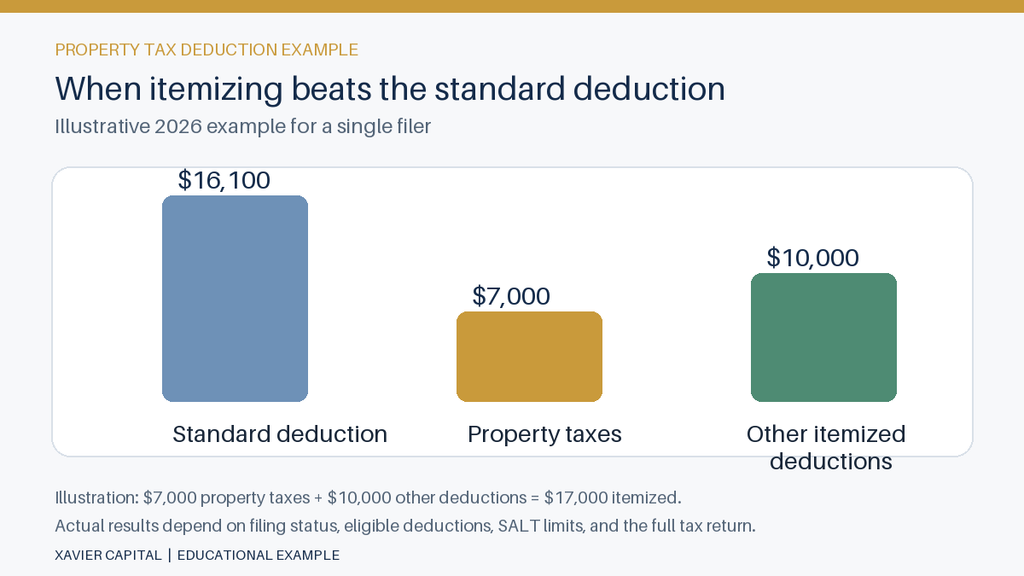
Consider a single filer in 2026 with $7,000 of qualifying property taxes, $8,000 of qualifying mortgage interest, and $2,000 of eligible charitable contributions. The illustrative itemized total is $17,000. That is only $900 above the $16,100 standard deduction, before considering any other tax rules that may affect the return.
The example shows why a property tax payment does not automatically create a dollar-for-dollar tax saving. The deduction reduces taxable income. It does not reduce the tax bill by the full amount of the property tax paid.
A simple itemizing comparison
The illustration below compares the 2026 standard deduction for a single filer with a hypothetical itemized total that includes property taxes and other deductions. It is not a personal tax calculation.
In this example, property taxes are useful because they help the total itemized deductions exceed the standard deduction. If the taxpayer had only the $7,000 property tax bill and no other qualifying deductions, itemizing would generally be less favorable than taking the standard deduction.
Which property taxes generally qualify?
A personal property tax deduction generally applies to a real estate tax imposed by a state or local government and based on the value of the property. Common examples include qualifying county, municipal, and school-district real estate taxes.
The name printed on the bill is not enough by itself. Review what each charge represents. A bill may include taxes, assessments, fees, and service charges that do not receive the same treatment.
The following amounts generally do not qualify as a personal real estate tax deduction:
- homeowners association dues;
- charges for water, trash collection, or similar services;
- transfer taxes;
- recording or registration fees; and
- special assessments that pay for improvements such as a new sidewalk, road, or sewer connection.
A special assessment for an improvement may still matter for your tax records. It may increase the property’s tax basis rather than create a current deduction. Keep the assessment notice and related documents in case you later sell the property .
Interest and penalties on late property tax payments are also not the same as deductible property taxes.
Escrow accounts and mortgage statements
Mortgage escrow is a common source of confusion. Depositing money into your lender’s escrow account is generally not the same as paying the local taxing authority.
For a cash-basis taxpayer, the deductible amount generally follows the amount the lender actually paid to the taxing authority during the year. Review your annual mortgage statement and compare it with the local tax records if the amounts do not match.
Do not deduct both your monthly escrow deposits and the property tax payment made from escrow. That would count the same tax twice.
Buying or selling a home during the year
If you bought or sold a home, review the settlement statement carefully. The closing documents may allocate property taxes between the buyer and seller, including reimbursements for taxes paid in advance.
The tax treatment depends on the facts and the allocation shown in the closing documents. Keep the settlement statement, tax bill, and proof of payment with your tax records. Do not assume that every amount listed under closing costs is an annual deductible property tax.
Recording fees , title charges, transfer taxes, and other transaction costs may follow different rules from annual real estate taxes.
Rental and business property are different
Property taxes connected to a rental property are generally handled as rental expenses on Schedule E rather than as personal itemized deductions on Schedule A. The personal SALT limit generally does not apply in the same way to the portion properly connected to rental activity.
If you rent only part of your home, divide the property taxes between personal and rental use using a reasonable allocation method, such as the portion of the home used for the rental activity. Keep records supporting the percentage used.
Property taxes connected to property used in a trade or business may be deductible as a business expense when they are ordinary, necessary, and properly connected to that activity. Personal expenses do not become business deductions simply because you work from home.
Vacation homes can require additional calculations when the property is both rented and used personally. Rental days, personal-use days, and the allocation of shared expenses can affect the result.
Keep records that support the deduction
Keep the documents that show what you were charged, what you paid, and what the payment covered. Useful records may include:
- the annual property tax bill;
- payment confirmations or canceled checks;
- mortgage escrow statements;
- settlement statements from a purchase or sale;
- special-assessment notices; and
- allocation records for rental or business use.
A digital folder organized by property and tax year is usually enough for practical recordkeeping. Property records can also matter later when calculating the basis and taxable gain on a sale.
Frequently asked questions
Can I deduct property taxes if I take the standard deduction?
Generally, personal property taxes are claimed as an itemized deduction. If you take the standard deduction, you generally do not add your personal property taxes separately. Rental and business property taxes may follow different rules.
Can I deduct property taxes paid through mortgage escrow?
Generally, yes, but the relevant payment is usually the amount the lender actually sent to the taxing authority during the year. Escrow deposits alone are not the same as a completed tax payment.
Are HOA fees deductible for a personal residence?
Usually not. HOA dues are generally personal expenses for a home you use personally. They may be deductible as an ordinary and necessary rental expense when connected to a rental property.
Can I deduct a special assessment?
Usually not as a current personal property tax deduction when it pays for an improvement, such as a road, sidewalk, or sewer connection. It may instead affect the property’s tax basis. A charge for ordinary maintenance or repair may require a different analysis.
Does the SALT limit apply to rental-property taxes?
The personal SALT limit applies to itemized deductions on Schedule A. Property taxes properly allocated to rental activity are generally reported with the rental activity on Schedule E and follow the rules for that activity.
Plan before December 31
Property tax planning works best before the year closes. Estimate whether you are likely to itemize, review your available SALT room, and separate personal, rental, business, and improvement-related costs as they occur.
Do not prepay a tax installment only to create a deduction without first checking whether you will itemize and whether the payment fits within the applicable rules. Sending cash early does not help if the deduction does not improve your tax result .
The practical lesson is simple: property taxes can be deductible, but the benefit depends on timing, classification, the SALT limit, and whether itemizing beats the standard deduction.
For a related explanation of the 2026 federal tax brackets, see What the 2026 Tax Brackets Mean for You. For broader household planning, see How to Create an Annual Budget Plan for 2026.
This article is for educational purposes only and is not tax, legal, or financial advice. Tax rules can change, and individual circumstances differ. Review current IRS guidance or consult a qualified tax professional about your situation.