

Student loan forgiveness in 2026 can sound simple in a headline. In practice, there is no single federal program that cancels every borrower’s balance. Eligibility can depend on your loan type, repayment plan, employment, payment history, and when your loans were first disbursed.
This guide covers major federal options available or affected by the rules in place as of October 5, 2026. It is educational information, not a personal eligibility decision .
1. Public Service Loan Forgiveness
Public Service Loan Forgiveness, or PSLF, may apply to borrowers who work full time for an eligible government or nonprofit employer. The program generally requires eligible Direct Loans and 120 qualifying monthly payments under an income-driven repayment (IDR) plan. Meeting the payment count alone is not enough: the employment and loan requirements matter too. Repayment Plans | Federal Student Aid
Borrowers should check their employer and payment history through the official PSLF tools. Keep records of employment certifications and loan payments, since a count of 120 payments does not by itself confirm that every other requirement has been met.
2. The Repayment Assistance Plan
The Repayment Assistance Plan, or RAP, became available starting July 1, 2026, for eligible federal borrowers. Its monthly payment is based in part on adjusted gross income and dependents, so the amount can vary from one household to another .
For eligible borrowers who are not pursuing PSLF, an unpaid balance may be forgiven after 30 years of qualifying RAP payments. Some eligible borrowers pursuing PSLF may qualify for forgiveness after 10 years, subject to the separate PSLF requirements. RAP eligibility also depends on loan type and disbursement history.
This makes it important to distinguish between having a low payment and qualifying for forgiveness. They are related, but one does not automatically guarantee the other.
3. A simple RAP payment example
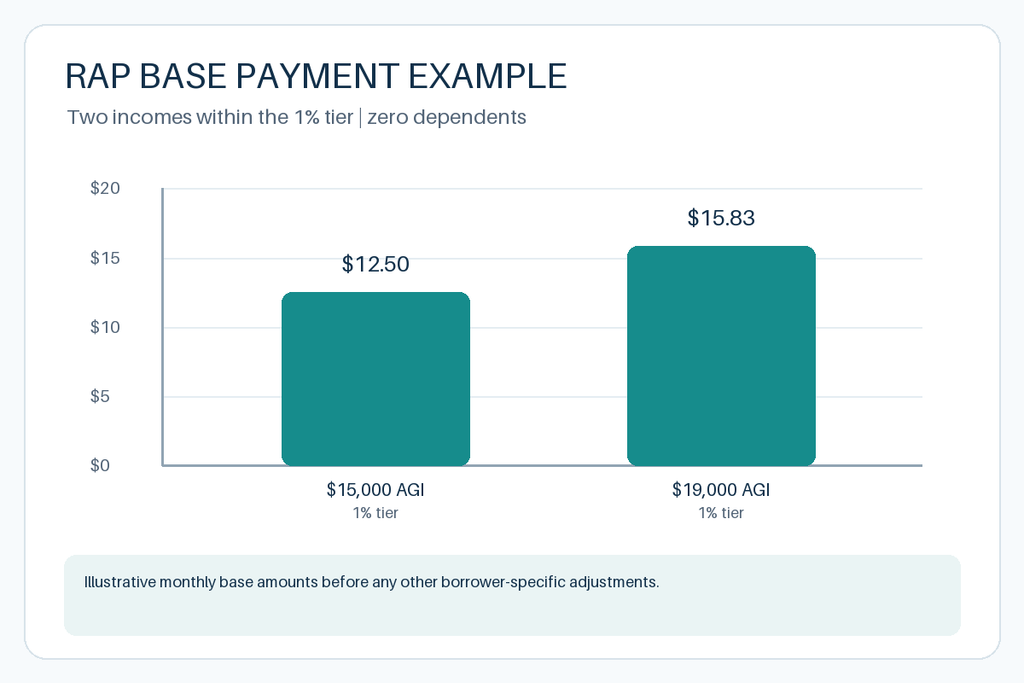
Assume a borrower has $19,000 in adjusted gross income, falls within the 1% tier, and has no dependents. The illustrative base payment would be:
- $19,000 × 1% = $190 per year
- $190 ÷ 12 = about $15.83 per month
This is a simplified base-payment example, not a personal payment estimate. Qualifying dependents and the $10 monthly minimum can change the final amount. How RAP student loan payments are calculated
4. Why the date of a loan matters
Federal repayment options changed on July 1, 2026. For some borrowers, having a loan first disbursed on or after that date affects which plans are available. Eligible borrowers with newer loans may have access to RAP and the Tiered Standard Plan, while borrowers with earlier loan histories may have different options.
If you have loans from different years, do not assume that every loan follows the same rules. Review each loan’s type and first-disbursement date, then compare the plans currently available to you through Federal Student Aid.
5. Other federal forgiveness and discharge options
PSLF and income-driven repayment are not the only possible routes. Depending on a borrower’s circumstances, federal programs may include Teacher Loan Forgiveness or discharges connected to situations such as a closed school, a qualifying disability, or borrower defense.
These programs have their own conditions. For example, working in education or having attended a school that later closed does not, by itself, confirm eligibility. Check the requirements for the specific program before making decisions based on a headline or a general summary .
Before deciding which option to pursue, review the eligibility requirements for the specific program and loan type. For a program-by-program overview of federal discharge options, including Teacher Loan Forgiveness, closed-school discharge, disability discharge, and borrower defense, see Edfinancial’s Complete List of Discharge Options .
A practical checklist
Before choosing a plan or assuming a loan will be forgiven:
- Confirm whether each loan is federal or private.
- Check the loan type and its first-disbursement date.
- If considering PSLF, verify that your employer and payments meet the current requirements.
- Compare the repayment plans available to your specific loans.
- Save your payment records and program communications.
The bottom line
Federal student loan forgiveness is possible for some borrowers, but the rules depend on the program and the borrower’s details. For 2026, RAP adds a new repayment path, while PSLF and other specific programs continue to have their own eligibility requirements.
The safest next step is to check your loan information and current plan options through Federal Student Aid, rather than relying on a broad claim that everyone qualifies. Forgiveness is a possibility under certain rules, not a guaranteed result.
Pingback: RAP Student Loan Payment Calculation: 2026 Examples
Pingback: RAP vs IBR Student Loans in 2026: Compare Payment Rules