

The Repayment Assistance Plan, or RAP, calculates payments using income and household details. The amount is not determined only by how much you owe, and the result can differ from one borrower to another.
This guide explains the basic calculation with simplified examples. It covers federal student loans and is educational, not a personal payment estimate.
The basic RAP payment formula
The simplified calculation has three steps:
- Apply the percentage for your adjusted gross income (AGI) tier to your AGI.
- Divide that annual amount by 12 to get a monthly base payment.
- Subtract $50 for each qualifying dependent, while keeping the payment at the $10 monthly minimum.
RAP percentages rise with income tiers. The exact amount can also depend on your loan eligibility and household details, so a manual example should not replace the current calculation from your servicer.
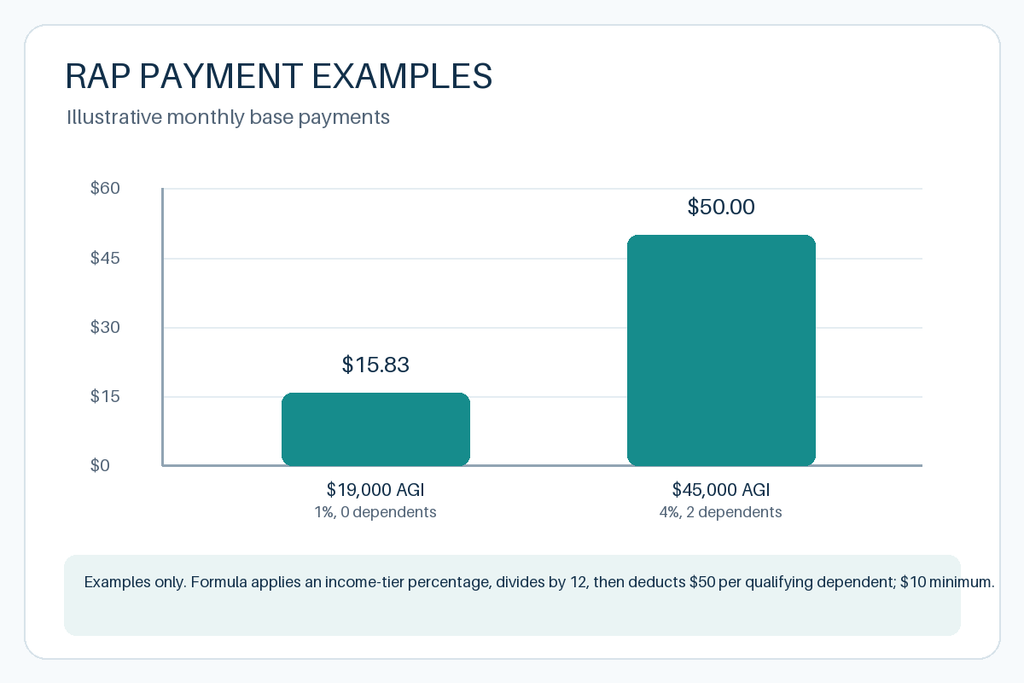
Example 1: $19,000 in AGI
Assume a borrower has $19,000 in AGI and falls within the 1% tier, with no dependents:
- $19,000 × 1% = $190 per year
- $190 ÷ 12 = about $15.83 per month
This is the simplified monthly base payment before any other borrower-specific adjustments.
Example 2: $45,000 in AGI
Assume a borrower has $45,000 in AGI, falls within the 4% tier, and has two qualifying dependents:
- $45,000 × 4% = $1,800 per year
- $1,800 ÷ 12 = $150 per month
- $150 − $100 for two dependents = $50 per month
If the dependent adjustment reduces the calculation below the minimum, the $10 monthly minimum applies. These examples use figures away from an income-tier boundary. For exact threshold amounts, check the current table or calculator from your loan servicer.
Details that can change your result
Before relying on an estimate, check:
- Your AGI: RAP uses income information, not just your current monthly paycheck.
- Dependents: The number reported for the calculation can affect the monthly amount.
- Tax filing details: Household and filing circumstances may affect how income is considered.
- Loan eligibility: RAP is a federal repayment option for eligible loans. Other loan histories can affect which plans are available.
Federal Student Aid explains that plan availability depends on the borrower’s loans and repayment history. Check your own options through its current repayment guidance before choosing a plan. Repayment Plans | Federal Student Aid
A payment estimate is not a forgiveness decision
A lower monthly payment does not, by itself, confirm that a borrower qualifies for loan forgiveness. Payment amount, qualifying payments, employment, and program eligibility are separate parts of the rules.
For the broader overview of federal options, start with the Xavier Capital guide to student loan forgiveness in 2026 . Always verify your personal calculation with Federal Student Aid or your loan servicer.
Before you make a decision
Use your official loan records and current repayment tools rather than relying on a generic example. A calculation can help explain the formula, but your actual payment depends on the information and eligibility rules that apply to you.