

RAP and IBR both connect payments to income, but they use different formulas and eligibility rules. The right comparison starts with your loan history, not with a headline or a single monthly-payment example.
Federal student loan repayment options changed in 2026. Borrowers comparing the new Repayment Assistance Plan (RAP) with Income-Based Repayment (IBR) need to look at more than the first payment estimate. Loan type, first-disbursement date, income, family details, and the length of repayment can all matter.
This article gives a general comparison for educational purposes. It cannot determine which plan an individual borrower qualifies for.
First, check your loan history
Start by listing each federal loan, its type, and its first-disbursement date. Changes that took effect on July 1, 2026 affect which income-driven plans some borrowers can choose. For certain eligible Direct Loans first disbursed on or after that date, RAP is the income-driven option available under the new rules. Borrowers with earlier loan histories may have different choices, including IBR, if they meet its requirements. Check the current options for your own loans before comparing payments. Federal Student Aid’s repayment-plan guidance
How RAP calculates payments
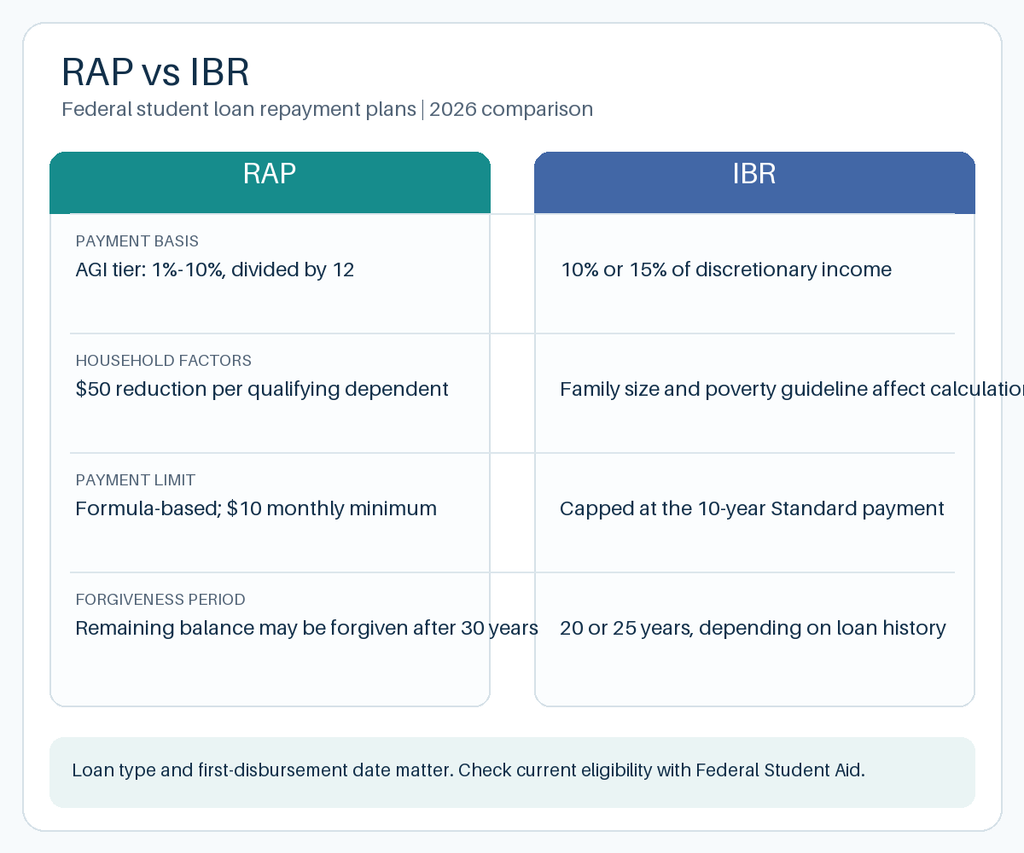
RAP uses an income-tier formula. The applicable percentage of adjusted gross income (AGI) is converted into a monthly base payment by dividing the annual amount by 12. The formula then reduces the payment by $50 for each qualifying dependent, subject to a $10 monthly minimum.
RAP percentages rise across income tiers. The remaining balance may be forgiven after 30 years of qualifying payments, but eligibility and payment details depend on the loan and the borrower’s information. A general description of the plan is available from Edfinancial’s RAP guidance .
How IBR calculates payments
IBR uses a different measure: discretionary income. In general, the payment is 10% or 15% of discretionary income, depending on the borrower’s loan history. Family size and the applicable poverty guideline help determine discretionary income. The payment is also capped at the amount due under the 10-year Standard Repayment Plan.
IBR may lead to forgiveness after 20 or 25 years of qualifying payments, depending on the borrower’s loan history and eligibility. Some loan-date and loan-type rules changed in 2026, so older IBR descriptions should not be assumed to apply to every borrower. See Edfinancial’s IBR guidance and confirm your available plans through Federal Student Aid.
The payment formulas are different
RAP starts with AGI and an income tier, then applies the dependent reduction and minimum. IBR starts with discretionary income, which takes family size and the poverty guideline into account, and applies the relevant percentage and payment cap.
Because the formulas use different inputs, comparing only two headline percentages can be misleading. The same borrower may see different estimates under each plan, and the lower initial payment does not automatically mean the lowest total cost over time.
Questions to ask before choosing
- Are all of your loans eligible for the plan you are considering?
- When was each loan first disbursed, and how does that date affect your choices?
- What does the official payment estimate show using your actual AGI and household details?
- How long might you remain in repayment under each option?
- Could a separate forgiveness program apply to your circumstances?
Use the current Federal Student Aid tools and your loan servicer’s records rather than relying on a generic example. A qualifying public-service route, if applicable, has its own requirements and should be checked separately.
Paul Xavier’s observation
A lower payment can help with monthly cash flow, but it is only one part of the decision. Borrowers should also compare eligibility, repayment length, how their household details affect the formula, and what forgiveness rules apply. No single plan is best for everyone, and a payment estimate is not a promise of forgiveness.
For the broader overview of federal student-loan options, read the Xavier Capital guide to student loan forgiveness in 2026 .