

Updated October 2, 2026.
Artificial intelligence may affect how businesses work and how workers perform certain tasks. But it is too early to say that AI will automatically make every high-income household richer or every other worker poorer.
The outcome depends on who can use the technology, how businesses share its benefits, and how work changes. Current measures of AI adoption can help describe use, but they do not by themselves measure changes in wages or household wealth.
AI adoption is not the same as income inequality
The Census Bureau’s Business Trends and Outlook Survey found that AI use varied by business size. Between December 2025 and May 3, 2026, 37% of businesses with at least 250 employees reported AI use, compared with fewer than 20% of businesses with four or fewer employees. That shows a difference in reported adoption, not proof that income inequality has increased. Census Bureau: AI Use at U.S. Businesses.
The broader employment outlook also needs careful interpretation. The BLS projects total employment growth of 3.5% from 2025 to 2035 and has introduced AI exposure categories for occupations. Neither measure tells us how future income gains will be divided among business owners, workers, and consumers. BLS Employment Projections, 2025–2035.
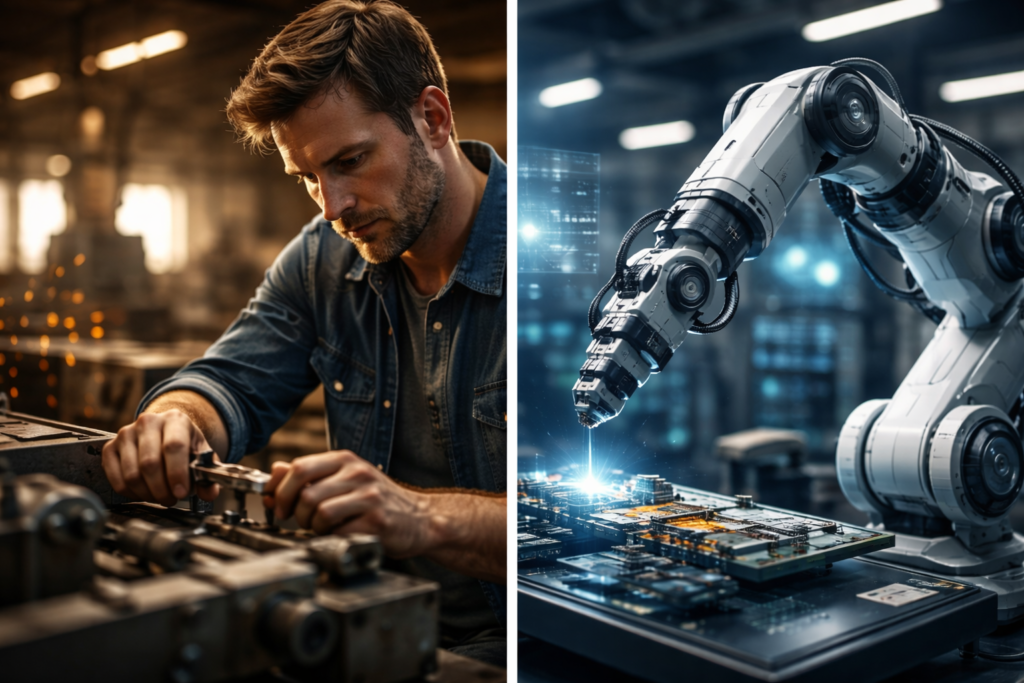
What could influence who benefits?
Access to tools and training
Workers and businesses do not all have the same access to technology, training, or time to learn new systems. If a tool is used only by some workers or companies, its benefits may also be uneven.
How businesses use productivity gains
If technology helps a business complete work more efficiently, the business could use the gains in different ways. It might invest in better service, lower costs, training, wages, or profits. Adoption data alone cannot tell which outcome will happen.
Changes to job tasks
Some roles may change as businesses automate or reorganize tasks. Workers may need to learn new processes, while employers may need to provide training. The effects can vary even among people with the same job title.
Ownership and bargaining power
Businesses that own technology or have the resources to adopt it may benefit differently from employees who use it in their work. The balance can depend on workplace policies, competition, skills, and how employers set pay.
What readers can do
- Ask how AI is changing the tasks in your own field, rather than relying on a broad prediction about all jobs.
- Compare the skills and qualifications requested in current job postings.
- Before paying for an AI course or business program, check its full price, terms, and specific curriculum.
- Treat claims of guaranteed income or quick wealth as warnings to investigate, not promises to rely on.
- Keep major career and financial decisions grounded in your household’s actual needs and resources.
More on Jobs, Income & AI
- AI and U.S. jobs: what may change and what workers can do
- The U.S. job market in 2026: hiring, pay, and how AI may change work
- The broader U.S. economic picture in 2026
Final thoughts
AI adoption is real, but adoption does not prove a particular income outcome. Rather than assume that inequality must rise or fall, it is more useful to watch how work changes, whether workers can access training, and how businesses distribute the gains.
Paul Xavier
Editor & Contributor at Xavier Capital
Siga o Xavier Capital: LinkedIn | Pinterest | Medium
Pingback: U.S. Job Market in 2026: Hiring, Pay, and How AI May Change Work
Pingback: AI and U.S. Jobs in 2026: What May Change and What Workers Can Do