

A rental property can produce a healthy rent check and still create a surprisingly large tax bill when expenses are tracked casually. The best tax deductions for landlords are usually not exotic strategies. They are the ordinary and necessary costs of owning, maintaining, financing, and managing a rental property – claimed accurately and supported by good records.
For 2026 planning, begin with the IRS guidance in Publication 527, Residential Rental Property, Publication 946, How To Depreciate Property, and Publication 925, Passive Activity and At-Risk Rules. These publications explain how rental expenses, improvements, depreciation, passive losses, and recordkeeping generally work.
Landlords who do not have enough tax withheld from other income may also need to make quarterly payments. For a broader explanation of this issue, read How to Calculate Estimated Tax Payments for 2026
The key lesson is simple: a legitimate expense that is not documented is much harder to defend – and much easier to lose.
“Rental income is only part of the equation. A landlord who understands basis, depreciation, and expense records is making a business decision, not just collecting rent.” – Paul Xavier
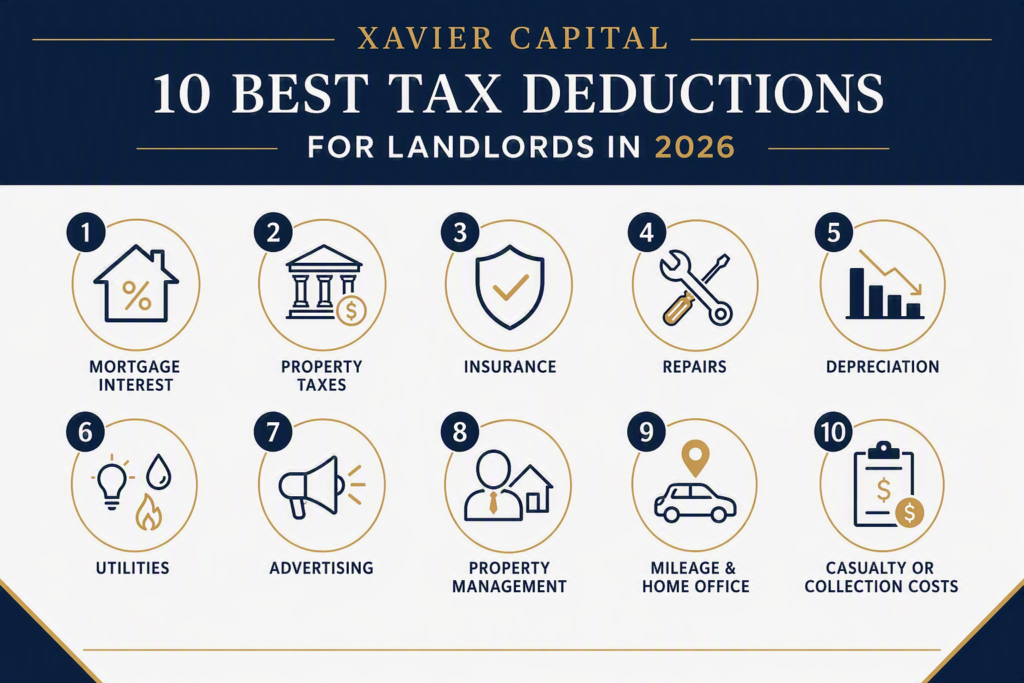
The 10 best landlord tax deductions to review
1. Mortgage interest
Mortgage interest is often one of the largest deductions for a rental-property owner, especially during the early years of a loan. Interest on debt used to buy, build, or improve a rental property is generally treated as a rental expense when the borrowing is properly connected to the property.
A lender’s annual interest statement can be a useful starting point, but compare it with your own payment records. Refinancing, multiple loans, cash-out proceeds, and loans secured by one property but used for another can change the analysis.
Do not deduct the principal portion of the mortgage payment. Principal builds equity, but it is not a current rental expense. Some loan fees also must be amortized over time instead of deducted immediately.
2. Property taxes
Property taxes allocated to a rental property are generally reported as a rental expense. Keep the tax bill, payment confirmation, and any allocation calculation if the property was partly personal, partly rented, or used for more than one activity.
This treatment is different from the personal tax rules many homeowners know. A rental expense belongs on the rental activity when it is properly connected to producing rental income.
3. Insurance and association dues
Landlord insurance, liability coverage, flood insurance, and other policies connected to the rental may be deductible. So may condominium or homeowners-association dues when they relate to the rental property.
Keep the policy declarations, annual statements, and proof of payment. If an insurance policy covers both personal and rental use, allocate the cost reasonably instead of deducting the entire premium automatically.
4. Repairs and maintenance
Repairs generally keep a property in its normal operating condition and are often deductible in the year paid. Common examples include fixing a leaking faucet, patching drywall, replacing a broken lock, repairing a garage-door opener, or fixing part of a fence.
Maintenance such as cleaning, painting, pest control, landscaping, snow removal, and routine turnover work may also qualify as a current expense when it is ordinary and necessary for the rental activity.
The important distinction is between a repair and an improvement. A repair fixes or maintains what already exists. An improvement makes the property better, restores it substantially, or adapts it to a new use. A new roof, major kitchen remodel, central-air installation, or new deck is more likely to be capitalized and depreciated.
Do not label a full renovation as a repair simply to obtain a faster deduction. The IRS looks at what the work accomplished, not only what the invoice calls it. Safe-harbor elections and other exceptions may apply, so keep invoices, contracts, payment records, and placed-in-service dates.
5. Depreciation
Depreciation is one of the most valuable deductions available to many residential landlords because it can reduce taxable rental income without requiring a new cash payment each year.
Residential rental buildings are generally depreciated over 27.5 years under the applicable federal method. Land is not depreciable. Your depreciable basis usually starts with the building portion of the purchase price, adjusted for certain acquisition costs and later capital improvements.
For example, if a property costs $300,000, you cannot automatically depreciate the entire amount. You generally need a reasonable allocation between land and the building. A new roof, HVAC system, or other major upgrade may create a separate depreciable asset.
Depreciation can lower current taxable income, but it also affects your basis and may contribute to depreciation recapture when you sell. That is a reason to plan – not a reason to ignore the deduction.
6. Utilities paid by the landlord
Water, trash service, gas, electricity, internet, and similar costs may be deductible when the landlord is responsible for them under the lease or operating arrangement.
Vacancy-period utilities are easy to overlook. Save the bills and note the period during which the property was available for rent. If you occupy part of the property or pay a utility that benefits both personal and rental areas, calculate and document the rental portion.
7. Advertising, tenant screening, and leasing costs
The costs of finding and qualifying tenants may generally be connected to the rental activity. Potential deductions include rental listings, online advertising, tenant-screening fees, lease-preparation services, showing-related costs, and reasonable placement fees.
Small charges can add up across several units. Create a property-specific category in your accounting system so these expenses do not disappear among personal transactions.
8. Property management and professional services
Property-management fees are a common rental expense. Depending on the facts, landlords may also deduct bookkeeping, tax-preparation fees attributable to the rental, legal advice about leases, eviction services, collection costs, and accounting support.
Office supplies, postage, rental-management software, bank fees, and online payment-processing charges may qualify when they are directly connected to managing the property.
A simple annual budget can make these recurring costs easier to organize. The Annual Budget Plan for 2026 explains how to map expected income and expenses throughout the year, which can also help a landlord identify missing records before tax season.
The connection matters. A lawyer’s fee for reviewing a lease is different from a fee for an unrelated personal estate plan. Separate business and personal records whenever possible.
9. Business travel, mileage, and a qualifying home office
Travel may be deductible when it has a genuine rental purpose, such as inspecting a property, meeting a contractor, showing a unit, collecting supplies, or handling repairs. A mileage log should record the date, destination, business purpose, and miles driven. Track parking and tolls as well.
Personal errands do not become deductible because you happened to drive past the rental. Mixed personal and business trips require careful allocation. A vacation with one brief property visit is not automatically a fully deductible business trip.
A home-office deduction may be available when part of the home is used regularly and exclusively for managing the rental activity and the other requirements are met. A dedicated workspace is easier to document than a kitchen table used by the entire household.
10. Certain casualty, theft, education, and collection costs
Some less frequent expenses deserve review. Depending on the circumstances and current IRS rules, these may include qualifying casualty or theft losses, landlord-law seminars, rent-collection charges, collection-agency fees, and legal costs related to unpaid rent or tenant disputes.
Education should be directly related to operating your existing rental activity. General education about buying future investments may receive different treatment. Keep the agenda, receipt, and a short note explaining how the expense relates to the property.
If a tenant’s security deposit becomes your income because you keep it for damage or unpaid rent, report the income and preserve records for the related repair or collection cost. Do not treat every deposit as income when it is still refundable under the lease.
A simple example: how expenses can reduce rental income
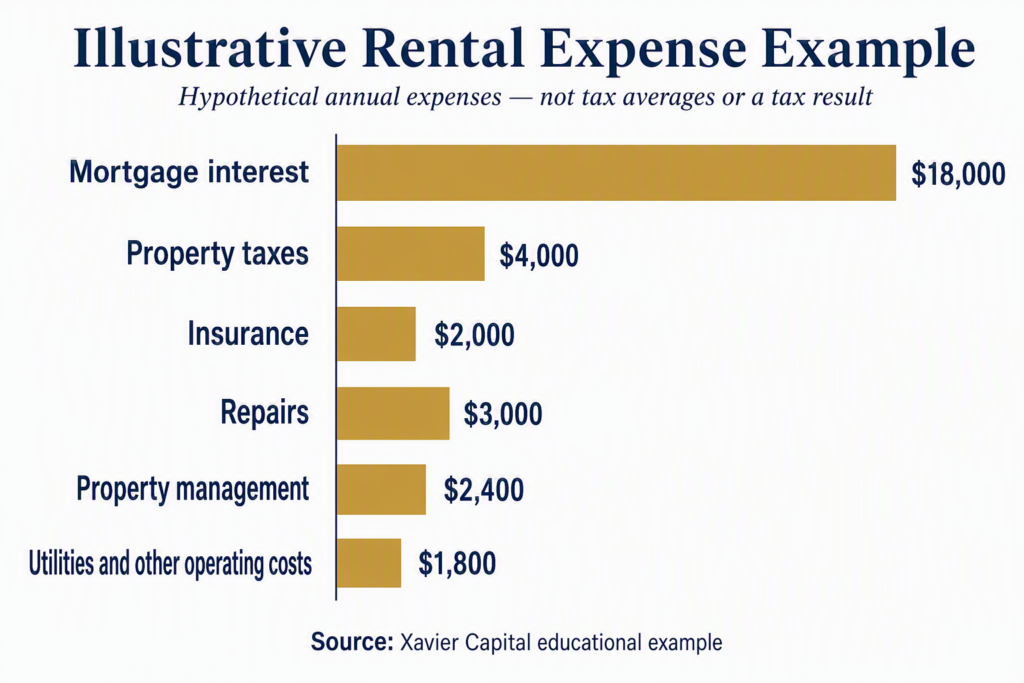
Assume a landlord receives $36,000 of annual rent and has the following illustrative expenses: $18,000 of mortgage interest, $4,000 of property taxes, $2,000 of insurance, $3,000 of repairs, $2,400 of management fees, and $1,800 of utilities and other operating costs. These expenses total $31,200 before depreciation, leaving $4,800 of net rental income before any depreciation deduction.
This is an educational example, not an average or a tax result. The actual treatment depends on the property’s basis, placed-in-service date, personal use, passive-activity rules, and the taxpayer’s complete return.
Rental losses are not always immediately usable
A rental loss on paper does not automatically reduce wages or other income dollar for dollar. Rental activities are generally treated as passive activities, and passive losses may be limited or carried forward.
Some taxpayers who actively participate in rental management may qualify for a special allowance for rental real-estate losses, subject to income limits and other rules. Real-estate professionals may receive different treatment if they meet strict statutory and participation tests.
Personal use also changes the calculation. If you rent a vacation property but use it personally, you may need to allocate income and expenses between rental days, personal days, and days the property was available for rent. Track occupancy carefully instead of relying on memory.
Records every landlord should keep
Create one folder or accounting category for each property. Keep:
- rental agreements and tenant records;
- mortgage statements and loan documents;
- property-tax bills and insurance statements;
- invoices, receipts, contracts, and proof of payment;
- mileage logs, tolls, and parking records;
- closing documents and land-building allocation support;
- improvement invoices and dates placed in service;
- depreciation schedules;
- occupancy, vacancy, and personal-use records; and
- copies of filed returns and related schedules.
Property records deserve special attention. Purchase documents, closing statements, improvement invoices, and depreciation schedules help establish basis. Keep them through the applicable record-retention period after the property is sold.
Frequently asked questions
Can landlords deduct the full cost of a new appliance?
Sometimes, but not always. An appliance may be a depreciable asset. A de minimis safe harbor or another election may affect the result, but eligibility and documentation matter. Keep the invoice, purchase date, placed-in-service date, and any election records.
Can I deduct rent that a tenant never paid?
Usually not if you use the cash method, which is common for individual landlords. Unpaid rent generally was not included in income, so it is not usually a current deduction. Qualifying legal, collection, or eviction costs may be treated separately.
How long should landlords keep records?
Keep support for income and expenses for at least as long as the IRS may examine the return. Keep property basis, improvement, and depreciation records longer – generally through the sale and the applicable limitation period afterward.
Bottom line
The best landlord deductions are not about forcing personal spending into a tax category. They are about identifying legitimate rental costs, separating repairs from improvements, calculating depreciation correctly, and keeping records before tax season arrives.
A well-run rental property is not only about collecting higher rent. It is also about knowing where every dollar went and how that dollar should be treated under the tax rules.
Next step: review the last 12 months of transactions by property, compare them with the 10 categories above, and flag anything that is missing an invoice, business purpose, or personal-versus-rental allocation.
Educational content only. Rental-tax treatment depends on your facts, elections, accounting method, personal use, and applicable federal and state rules. Consult a qualified tax professional before filing.