

A clear, beginner-friendly guide for freelancers, sole proprietors, and side-hustle owners.
A $400 laptop, a $900 client dinner, and a $1,200 home-office claim can affect your tax bill very differently. The important question is not simply whether you spent money while running your business. It is whether the expense meets the IRS standard for a business deduction .
For the 2026 tax year, this guide explains how to think about common Schedule C expenses, what records to keep, and where self-employed taxpayers should be especially careful.
“The best deduction is not the biggest number you can put on a form. It is the expense you can explain, document, and connect to earning business income without hesitation.” – Paul Xavier
Important: This article is for general education. Tax rules depend on your facts, business structure, and current IRS guidance. Consult a qualified tax professional before filing.
What Is Schedule C?
Schedule C, Profit or Loss From Business, is generally used by individuals who operate a business as a sole proprietor. It is also commonly used by single-member LLCs that have not elected to be taxed as corporations.
For the official form and filing information, see the IRS Schedule C page
On Schedule C, you report business income and subtract eligible business expenses to calculate your net profit or loss. That result generally flows to your individual tax return. Net profit may also be subject to self-employment tax, so accurate expense tracking can affect more than income tax alone.
The basic test is simple: a deductible business expense must generally be ordinary and necessary for your trade or business.
- Ordinary means common and accepted in your type of business.
- Necessary means helpful and appropriate for your business. It does not mean the business would be unable to survive without the expense.
Before calling a purchase deductible, ask:
- Was it primarily for the business?
- Is it reasonable for the type and size of the business?
- Can I prove the amount, date, payee, and business purpose?
A business deduction does not turn a personal purchase into a business purchase. If an item has both business and personal use, you generally need to separate the business portion using a reasonable, documented method .
Common Schedule C Expense Categories
The categories below can help organize your records. The correct treatment depends on the facts, and some expenses may belong on a different tax form or schedule .
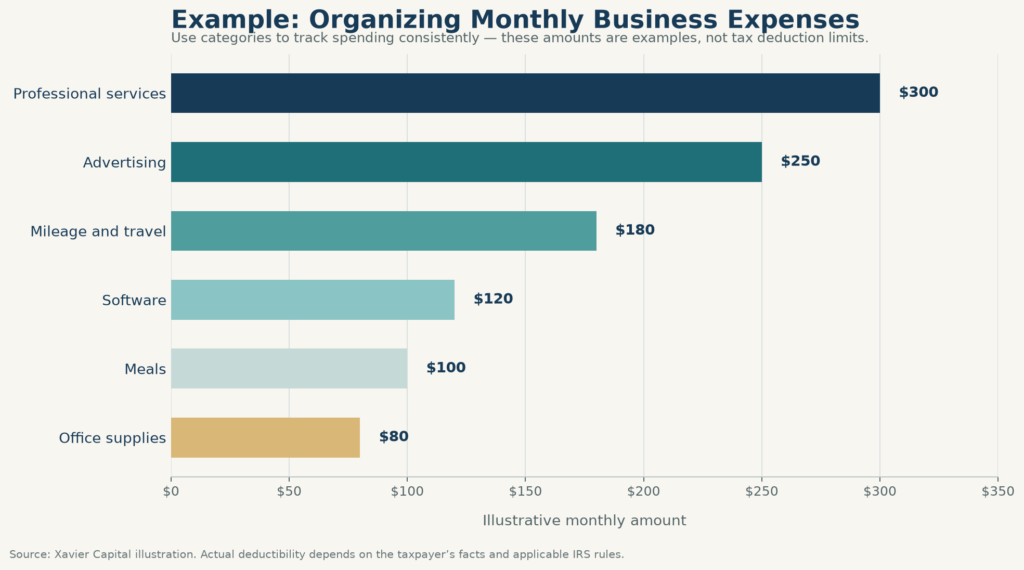
Advertising, Marketing, and Online Business Costs
Advertising and promotion may include:
- Website hosting and domain renewals
- Paid search and social media advertising
- Printed marketing materials
- Business cards and promotional design
- Local sponsorships connected to the business
- Email marketing software
- Reasonable costs for producing business content
Software subscriptions may belong under office expenses or other expenses, depending on how you organize your return. Common examples include bookkeeping platforms, project-management tools, cloud storage, design software, scheduling tools, and video-conferencing services .
Save the receipt and make a short note explaining how the service supports your business. A subscription is easier to defend when the business purpose is clear from the records.
Office Expenses, Supplies, and Professional Services
Small recurring costs can add up during the year. Possible business expenses include postage, printer ink, shipping materials, paper, business bank fees, and supplies consumed while providing a service.
If materials become part of a product you sell, they may need to be treated as inventory or cost of goods sold instead of ordinary office supplies. Classification matters because different rules may apply.
Professional fees may be deductible when they relate directly to the business. Examples include:
- Business bookkeeping
- Tax preparation for the business portion of your return
- Legal advice and contract review
- Business consulting
- Payments to independent contractors
Paying a contractor does not always end your reporting obligations. Depending on the payment, the contractor, and the circumstances, information-reporting requirements may apply. Keep complete records of who was paid, how much, when, and for what service.
Insurance, Rent, and Utilities
Business liability insurance, errors and omissions coverage, and commercial property insurance are common examples of business-related insurance costs.
Personal life insurance is generally not a Schedule C business deduction simply because you own a business.
Rent may include a leased studio, retail space, storage unit, or equipment used for the business. Utilities for a dedicated business location may also qualify.
When a cost serves both your household and your business, only the business portion generally belongs on Schedule C. A household internet plan, for example, normally requires a reasonable allocation if it is used for both personal and business purposes.
Education and Training
Education expenses may qualify when they maintain or improve skills needed in your current business. For example, an established freelance designer may be able to connect an advanced design course to the services already offered to clients.
Training that qualifies you for a new trade or business generally receives different treatment. This distinction is important for people changing careers or starting a completely new type of work.
Keep the course description, receipt, date, and a short explanation of how the training relates to your existing business activity.
Business Travel and Meals
business travel requires a genuine business purpose away from your tax home. Transportation, lodging, and certain related costs may qualify, but personal days, sightseeing, and personal side trips must be separated.
Business meals are generally subject to a 50% limitation when they meet the applicable requirements and are not lavish or extravagant under the circumstances. Record the following while the details are fresh:
- Who attended
- Where the meal took place
- The amount paid
- The date
- The business purpose
A vague bank statement entry is not a complete explanation. A short contemporaneous note can make the record much stronger.
Vehicle Expenses: Choose a Method and Keep a Log
Vehicle deductions require extra care because business driving and personal driving often happen in the same car.
Depending on the facts, a taxpayer may use the standard mileage method or the actual-expense method. The standard mileage method uses the IRS rate for the applicable year. The actual-expense method may include fuel, repairs, insurance, registration, depreciation, and lease payments, with the business-use percentage applied where appropriate.
Do not claim the full cost of a mixed-use vehicle. Track business miles as they occur. A useful mileage log records:
- Date
- Starting point and destination
- Business purpose
- Business miles
Driving from home to a regular work location is generally personal commuting. Driving from a regular office to meet a client, collect supplies, or visit a job site is a different type of trip and should be documented accordingly.
Home-Office Deductions: The Exclusive-Use Rule Matters
A home-office deduction may be available when part of the home is used regularly and exclusively for business. A desk in a family room that also serves as a homework station may not satisfy the exclusive-use requirement.
A dedicated room or clearly separate area used only for bookkeeping, consulting, client work, or product fulfillment may be more appropriate, assuming the other requirements are met.
Eligible taxpayers may use a simplified method or calculate actual expenses based on the business-use percentage of the home. The simplified method reduces recordkeeping. The actual method may produce a larger deduction in some situations but requires more detailed records.
The larger deduction is not always the better choice if you cannot support it. Keep measurements, housing-cost records, and a consistent calculation method.
Expenses That Usually Do Not Belong on Schedule C
Having a business does not make every purchase a business expense. Common personal expenses that generally do not belong on Schedule C include:
- Personal groceries
- Ordinary clothing that can be worn outside work
- Personal medical expenses
- Daily commuting
- Family vacations
- Personal entertainment
Some self-employed tax benefits may be handled elsewhere on the tax return instead of as Schedule C expenses. Examples may include self-employed health insurance, certain retirement-plan contributions, and the deductible portion of self-employment tax, each subject to its own rules.
Large Purchases May Need Special Treatment
Computers, cameras, machinery, furniture, and vehicles may need to be depreciated over time. Certain tax provisions may allow faster deductions in qualifying situations, but the treatment depends on the type of asset, business-use percentage, placed-in-service date, and rules in effect for the tax year.
Do not automatically expense every major purchase just because the credit-card charge occurred in 2026. Keep the invoice, date placed in service, business-use percentage, and any supporting calculation.
Build Records That Can Defend the Deduction
Good bookkeeping is not about creating a mountain of receipts. It is about creating a clear trail from the expense to the business activity .
A practical system includes:
- Use a dedicated business account when possible.
- Save digital receipts in organized folders.
- Reconcile transactions every month.
- Add a short business-purpose note to unclear expenses.
- Track mileage and mixed-use costs continuously.
- Keep records that match the amounts reported on the return.
For a mixed-use phone, document how you calculated the business percentage. For a home office, retain measurements and household cost records. Estimates created months later are usually harder to explain than a consistent habit maintained throughout the year.
The IRS often recommends keeping tax records for at least three years, although longer retention may be sensible for property, depreciation, and other situations. Ask a qualified tax professional how long your specific records should be kept.
For broader tax planning, read How to Calculate Estimated Tax Payments for 2026.
For business cash-flow organization, see Annual Budget Plan 2026.
Retirement planning can also connect with business tax decisions. See Traditional vs. Roth 401(k) in 2026.
Frequently Asked Questions
Can I deduct expenses before my business earns income?
Possibly. Ordinary operating expenses may be deductible when you are actively carrying on a business, even during an unprofitable year. Start-up costs before operations begin follow separate rules. A hobby is not automatically treated as a business, so profit motive and businesslike activity matter.
Can I deduct my cell phone and internet bill?
You may be able to deduct the business-use portion. Keep a reasonable method for separating personal and business use. Claiming 100% of a household plan without a clear business-only arrangement can be difficult to support.
Do I need receipts for every Schedule C expense?
You need records that substantiate the deduction, and receipts are an important part of that proof. Travel, meals, vehicles, and larger purchases deserve especially careful documentation. Digital receipts are often easier to organize than paper receipts stored in one place.
Can a Schedule C loss reduce my other income?
It can in some situations, but limits may apply. The activity must be a real business, and rules involving at-risk amounts, passive activities, and excess business losses may affect the result. A recurring loss should be reviewed with a qualified tax professional.
Final Takeaway
Your expense records are more than tax-season paperwork. They show what your business actually costs to run, where margins are thinning, and which spending supports revenue.
Treat every deductible dollar as a decision worth documenting – not a number you hope will survive a closer look. A well-organized Schedule C starts long before tax filing season, with consistent records and a clear connection between each expense and the business activity it supports.
Editorial Sources
This article was prepared using the IRS Schedule C instructions, IRS business-expense guidance, IRS recordkeeping guidance, and IRS travel and meal-expense resources available for the applicable tax year. Review the latest official IRS guidance before filing.